“…and today we’re talking about a creature that can walk forward and why that’s interesting. But more on that later.”
Two cohorts meet on a beach, marching forward to meet one another head on… both flying the same blue colors. There’s no reason to fight, in fact, they are much stronger together… the soldier crabs combine their might to become an unassailable force. As individuals, they are humble, but together they are like the flowing tides of Life, Death, and Taxonomy.
Description of the Soldier Crab
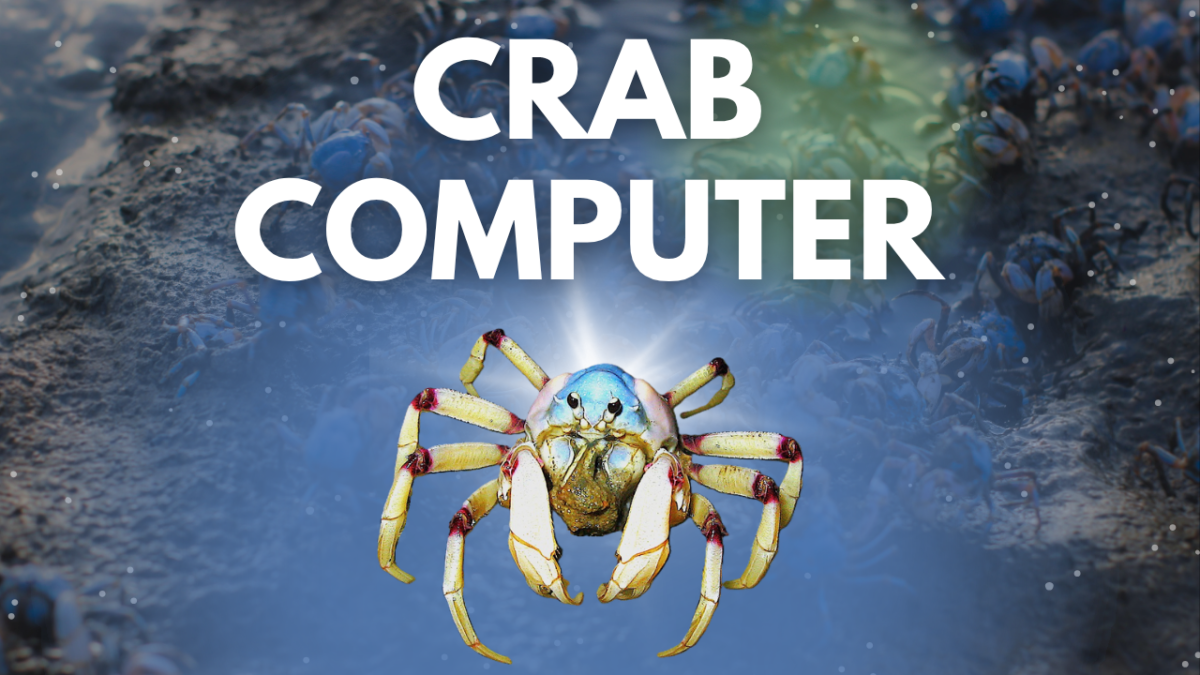
- Looks like somebody crossed a ping-pong ball with a wind-up toy and gave it ten tiny legs.
- Usually a powdery sky-blue to bluish-gray color, although they can appear pale white after molting or when coated in sand.
- Smooth, almost porcelain-looking shell with surprisingly long, delicate legs that seem way too skinny for all the marching they do.
- Small black eyes sit on short stalks, giving them a permanently suspicious expression.
- Their oversized claws are fairly modest compared to many crabs, making them look more like tiny engineers than heavyweight boxers.
- When thousands gather together, the beach suddenly looks like it’s being attacked by sentient blue marbles.
Measure Up
Welcome to the beloved Measure Up segment. The official listener’s favorite part of the show! The part of the show when we present the animal’s size and dimension in relatable terms through a quiz that’s fun for the whole family. It’s also the part of the show that’s introduced by you when you send in audio of yourself saying, singing, or chittering the words Measure Up into ldtaxonomy at gmail dot com.
Male Body Size
The body is up to 25 mm (0.98 in) across
In the summer of 2021, Italian brothers Alberto and Giuseppe Rosso earned a Guinness World Record after growing the world’s heaviest Carmen cherry at 33.05-gram (1.16-ounce). True or False – five crab lengths go into the circumference of that cherry.
True. The circumference was 5 inches.
Female Body Size
Females are slightly smaller at 11.2 mm.
The tallest tree in Australia is a mountain ash (Eucalyptus regnans) named ‘Centurion.’ It’s in the Eucalyptus family. They reach their maximum height in about 200 years. True or False – 8,893 crabs go into the height of Centurion.
True. The tree stands at 99.6 m (326.8 ft)
Fast Facts about the Soldier Crab
- Range: Found along the tropical and subtropical coastlines of Australia, especially Queensland, New South Wales, and parts of Western Australia.
- Habitat: They inhabit sandy tidal flats, estuaries, mangrove edges, and sheltered beaches where they can burrow into wet sand between tides.
- Diet: Deposit feeders that sift microscopic algae, bacteria, detritus, and organic material from sand using specialized mouthparts.
- Foraging Behavior: Entire armies emerge with the falling tide and march across mudflats in coordinated swarms, constantly shoveling sand into their mouths before spitting out neat little pellets behind them.
- Mating: Breeding usually occurs during the warmer months. After mating, females carry fertilized eggs beneath their abdomen until the larvae hatch into the open ocean.
- Social Behavior: Unlike many crabs that treat every encounter like a bar fight, soldier crabs genuinely enjoy safety in numbers, often traveling in massive groups containing thousands of individuals.
- Lifespan: Most are thought to live around 2–4 years, though exact lifespans in the wild are still being studied.
- Predators: Shorebirds, gulls, herons, fish, rays, octopuses, and larger crabs all appreciate an all-you-can-eat soldier crab buffet.
- Sounds: They’re mostly silent, although a large marching swarm produces a faint rustling or clicking as thousands of tiny legs shuffle across the sand.
- Cool Quirk: When danger appears, the entire swarm can vanish underground in seconds. It’s less “military retreat” and more “everyone simultaneously remembered they left the oven on.”
Major Fact: Joining Forces
Could crabs compute?
Soldier crabs naturally form cohesive swarms. When two groups meet in the wilderness, they don’t fight or scatter…
Although individual crabs wander somewhat unpredictably, the swarm behaves like a single entity. When two swarms meet, they merge and continue moving in a direction determined by the combined motion of both groups.
There are a lot of reasons to swarm in nature. There’s safety in numbers, they have the appearance of a larger creature, there are more eyes to detect danger…but this predictable rule following behavior is also the kind of thing that can be harnessed for computation.
Researchers at Kobe University in Japan and the University of the West of England built a crab computer…
What do you mean computer?
Computers process information with electricity using transistors. Each transistor follows one very simple rule: “If I receive a certain electrical signal, I’ll let electricity pass. Otherwise, I won’t.”
But when you connect billions of these tiny switches together, they can perform logic.
So, an individual transistor doesn’t need to “know” anything about the task being performed, they just need to be able to follow simple rules.
The concept of a crab computer is that you replace the electricity with crabs.
The research team built a maze of channels and guided groups of about 40 crabs using an overhead shadow that mimicked a predator. The crabs instinctively moved away from the shadow, allowing researchers to direct the swarms through the maze. Depending on whether one or two swarms entered a junction, the merged swarm exited along different paths, implementing simple logic gates such as OR and AND…
Crab Logic
AND & OR gates are the fundamental building blocks of all digital computers.
Imagine you release one crab swarm from the left if Input A = 1.
And you release another swarm from the right if Input B = 1.
What if they come to an OR gate?
If either swarm arrives, a swarm exits the output.
No swarm enters? No output.
One swarm enters? Output.
Both swarms enter? Still output.
That’s what an OR gate does.
What if they come to an AND gate?
To make an AND gate, redesign the channels so that only when both swarms collide together do they continue into the output corridor.
One swarm? No output.
Both swarms? Output.
The results…
The crab-based OR gate worked reliably, while the AND gate was less consistent. Even so, the experiments demonstrated that living swarms can perform the fundamental logical operations required for computation.
Swarm Intelligence
The experiment shows something interesting about individuals and groups of animals…
The computation doesn’t come from the intelligence of individual crabs. One crab in a maze wouldn’t work. An individual crab is an animal with its own moment-to-moment choices, and it’s way too unpredictable. They may turn around, stop to groom, or go to sleep. The computer needs the collective behavior of many crabs.
Soldier crabs are a good example of swarm intelligence. A group can outperform an individual because of averaging… If we are trying to guess the jelly beans in a jar I might guess why too high you might guess way too low, but the average of 500 guesses is pretty close to accurate.
A crab swarm follows simple instincts:
- stay near other crabs
- avoid predators
- move away from shadows
- maintain spacing
And it helps them avoid predators and stay alive.
But, like a computer error, groups can make bad decisions based on bad inputs… the group may copy an individual that makes an error and then everyone is in trouble. Predators exploit this, like the humpback whale that herds schools of fish into a single cluster with a bubble net. In that case a maverick fish might survive…
In humans, the bystander effect is a good example.
Ending
So chill out off the coast of Australia, spit out some nice sand pellets, and get with your buddies to form a supercomputer like the soldier crab here in LDT.