
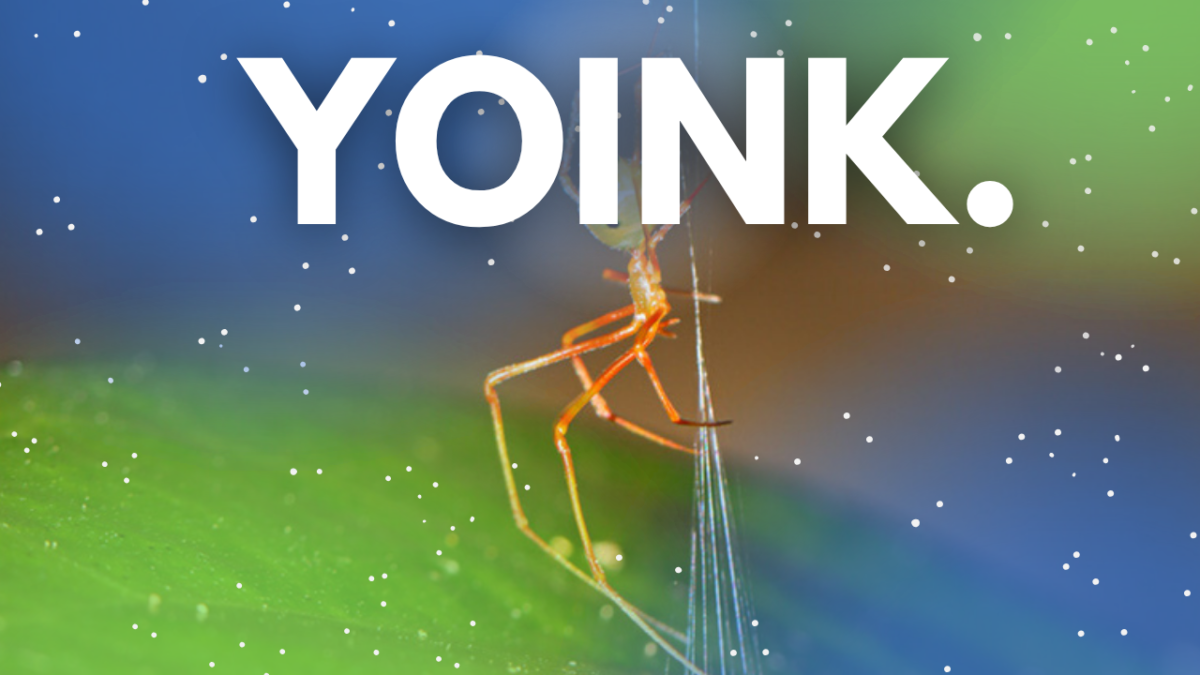
“…and today we’re talking about a brand new arachnid, just released in the latest update. But more on that later.”
Going after prey that’s larger than you can be dangerous… now, when that prey also has thousands of friends nearby, it’s truly a fools gambit… But what if you could yoink a single soldier away from her platoon at blistering speeds? Then you’d have a much easier time in Life Death and Taxonomy.
Thank you to Daniel White for the use of his song “Make Pangea Unified Again.” To hear more of Daniel’s music please visit Youtube dot com slash @DanielWhiteArtist.
Description of the Ballista Spider
- Tiny spider with a rounded, somewhat bulbous (even swollen) abdomen
- Generally greenish in the abdomen area with orange legs, with darker markings that look like false eyes. A quick glance makes it look like a big green ant.
- Eight really long, slender legs extending from a compact body
- Has the classic eight-eyed spider setup, although the eyes are tiny and difficult to spot without magnification
- Builds a small, funnel or cone-shaped web with which it does nothing interesting in particular
Measure Up
Welcome to the beloved Measure Up segment. The official listener’s favorite part of the show! The part of the show when we present the animal’s size and dimension in relatable terms through a quiz that’s fun for the whole family. It’s also the part of the show that’s introduced by you when you send in audio of yourself saying, singing, or chittering the words Measure Up into ldtaxonomy at gmail dot com.
Length
3 to 5 millimeters (roughly 0.12 to 0.2 inches)
The Carroballista was a cart-mounted ballista used by the Romans to fire bolts that were smaller than those in other forms of ballistae and generally made of metal. True or false – 294 spiders go into the width of the Carroballista.
True. The Carroballista was 1.47 m (4 ft 10 in) wide.
Web Trap
Despite their small size they can build a web trap about 30 cm (1 foot) long.
The polybolos was an ancient Greek repeating ballista, an early rapid-fire arrow launcher invented in the 3rd century BC by engineers working for Dionysius of Alexandria and later described by Philo of Byzantium. True or False – 8 ballista spider webs goes into the length of the polybolos.
True. 1.5–2.5 meters (5–8 feet)
Fast Facts about the Ballista Spider
Range: This most recent, as yet unnamed species was discovered in Queensland, Australia.
Habitat: They tend to hang out in vegetation, forests, gardens, and other places where they can string up their little orb webs.
Diet: Mostly tiny flying insects and other small arthropods that are unfortunate enough to wander into its web.
Social life: Solitary.
Predators: Small birds, other spiders, insects, and various small predators that eat tiny arthropods can all make a meal of them.
Major Fact: Yoink
Ballista spiders set a spring loaded trap capable of launching prey at incredible speeds.
The spider specializes on one particular prey species: the green tree ant (Oecophylla smaragdina). But that’s an issue because these ants are aggressive, territorial, and potentially dangerous prey. They can bite, spray defensive chemicals, and rapidly recruit other ants to attack a predator. Plus, they are as large or larger than our friend the ballista.
Rather than trying to overpower an ant directly, the spider has built a silk-powered catapult that lets physics capture the ant.
At night, the spider descends from its daytime hiding place and spends up to four hours constructing the trap. It creates a cone-shaped bundle containing roughly 15 to 60 tightly tensioned silk strands, anchored near the ground or on vegetation. The spider then connects this mechanism to its main web directly above.
Then the spider seems to exploit the ant’s anger management issue as the trigger.
The spider retreats to a safe distance after constructing the trap. A green tree ant encounters the cone and attacks it on site for some reason. Researchers suspect it smells like beef… By that I mean, they think the spider puts a chemical or pheromone on the silk that specifically attracts and provokes the ants… Although this part remains a hypothesis rather than something definitively demonstrated.
When the ant bites the cone, it releases the stored tension in the silk. But it’s sticky and they get wrapped up in it.
The result is basically a biological spring-loaded launcher:
- The ant is thrown more than 30 cm upward.
- The acceleration exceeds 1,300 m/s².
- The ant is launched into the spider’s main web.
Once the ant is securely entangled, the spider approaches and wraps it in silk.
Normally, attacking an ant could be a terrible idea for a spider because the victim’s nestmates can quickly swarm the predator. The ballista spider’s system allows it to separate an individual ant from the colony almost instantly and carry it away from the ant trail.
Ending
So set your trap, evade documentation for centuries, and quietly commit physics like the ballista spider here in LDT.