
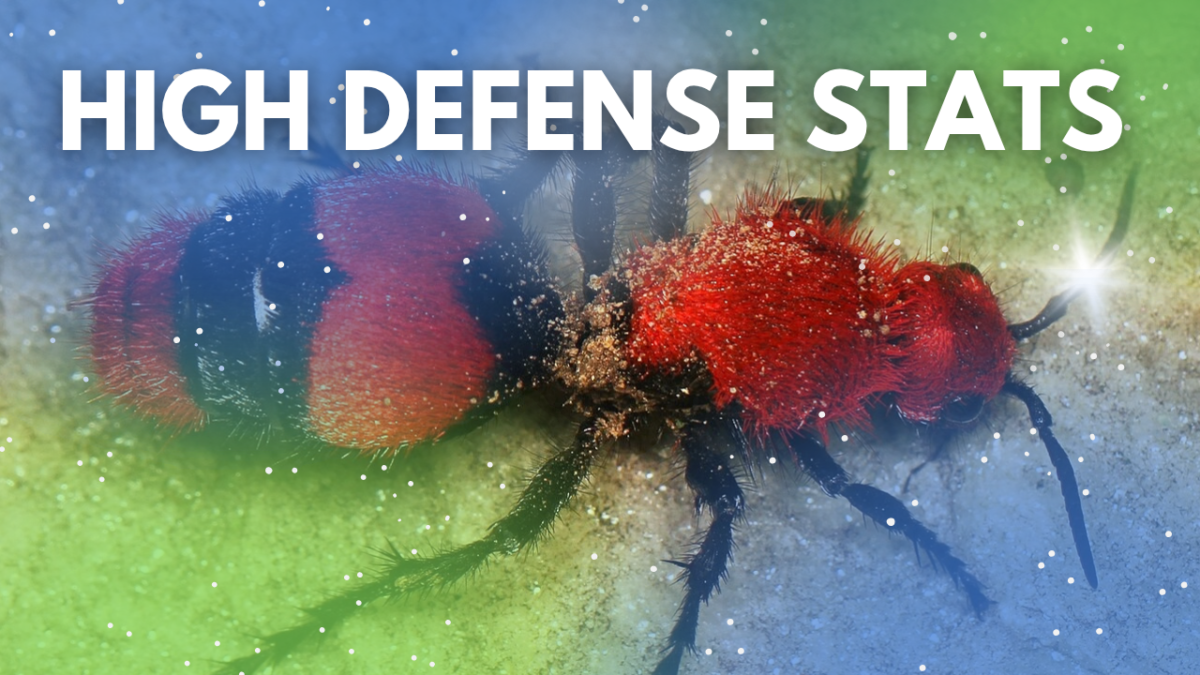
“…and today we’re talking about an ant that is-ant… but more on that later.”
Somewhere between a plush toy and the insect version of a honey badger lies the velvet ant. This borderline cute cluster of pom pom balls glued together hides a surprisingly complicated security system behind its pizazz. Bright colors, weird noises, suspicious smells, and some hardware you definitely don’t want to mess with all come together to make one very difficult snack for a typical predator. But sometimes the best defense is a good defense like the velvet ant here in Life, Death, and Taxonomy.
Description of the Velvet Ant
Velvet Ant is a parasitoid wasp that is often mistaken for an ant because of its appearance… and the thing they named it!
Females are wingless, like all female velvet ants, and have a striking black body with bright red coloring on the upper head, thorax, and abdomen.
Males have dark, translucent wings and lack a stinger.
Measure Up
Welcome to the beloved Measure Up segment. The official listener’s favorite part of the show! The part of the show when we present the animal’s size and dimension in relatable terms through a quiz that’s fun for the whole family. It’s also the part of the show that’s introduced by you when you send in audio of yourself saying, singing, or chittering the words Measure Up into ldtaxonomy at gmail dot com.
Female Length: about 15–25 mm (0.98 inches).
A coral cay archipelago stretching over 120 miles off the southern tip of the mainland, ending at Key West. Key Largo is the largest key. True or False — 150,747 wasps go into the width of Key Largo.
False. Key Largo is about 2 miles across at its widest.
Male Length: about 6–20 mm.
Guadalupe Peak, also known as Signal Peak, is the highest natural point in Texas. It’s within Guadalupe Mountains National Park and is part of the Guadalupe Mountains range, approximately 90 miles east of El Paso. True or False – 450,000 wasps go into the height of Guadalupe Peak.
False. Guadalupe Peak only has an elevation of 8,751 feet.
Fast Facts about Velvet Ant
The velvet ant is native to the eastern and south-central United States. Its range extends roughly from Florida north to Connecticut and Pennsylvania and west through Texas into parts of Colorado and Kansas.
They move quickly and may adopt a defensive posture when threatened.
Its extremely painful sting is rated 3 out of 4 on the Schmidt sting pain index, earning it the nickname “cow killer.” It also has a thick exoskeleton, fast evasive movement, warning coloration, venom, chemical defenses, and the ability to make a warning squeak by rubbing its abdominal segments together.
Both males and females can stridulate (make sounds by rubbing stuff like a cricket) when threatened. The species also participates in Müllerian mimicry (like a viceroy butterfly), sharing similar warning colors and patterns with other velvet ants.
This creates large networks of similarly defended species whose shared appearance helps predators learn to avoid them.
They are solitary, not colony-forming. Males search for females using their pheromones and even respond to the females’ stridulation sounds. Once a male finds a receptive female, he carries her to a sheltered location to mate. Females are believed to mate only once.
After mating, the female searches for nests of large ground-nesting wasps, such as cicada killers and horse guard wasps. She enters the nest and lays an egg on a host larva.
The egg quickly hatches, and the legless larva consumes the host before passing through several stages and eventually pupating. Pupation typically lasts about 23 days.
Major Fact: Five Layer Fake
- Richard Adams (Watership Down): “All the world will be your enemy, Prince with a Thousand Enemies, and whenever they catch you, they will kill you. But first they must catch you, digger, listener, runner, prince with the swift warning. Be cunning and full of tricks and your people shall never be destroyed.”
- The velvet ant takes the exact opposite approach to this. Easily caught, hard to kill
- Layer One: That flashy red-and-black coloration isn’t just for looking fabulous while sprinting through the grass. It’s aposematic coloration, essentially nature’s way of putting a giant “BAD IDEA” sticker on the animal. Predators can associate the colors with an unpleasant experience and decide to move along.
- Layer Two: The velvet ant’s exoskeleton is exceptionally tough. Experiments found that it took about 11 times more force to crush a velvet ant’s exoskeleton than a honeybee’s. The rounded, slippery body also makes it difficult for an attacker to get a good grip or deliver a clean bite.
- Layer Three:. When grabbed or attacked, the velvet ant can rub body structures together to produce a stridulatory sound. It’s basically a tiny biological alarm system.
- Layer Four:. It can release an unpleasant chemical secretion from its mandibular glands. So if the predator ignores the colors, ignores the armor, and ignores the weird warning noises, it gets introduced to the insect equivalent of pepper spray.
- Layer Five: The Stinger. Female velvet ants have a powerful venomous sting delivered through a modified ovipositor. The sting is defensive rather than an offensive hunting weapon, and males don’t have a stinger at all.
- These defenses work as a layered system, meaning a predator doesn’t have to get all the way to the sting before deciding that lunch has become a terrible life choice. It’s essentially a five-stage customer-service escalation where every department gets progressively more unpleasant.
- The hard body helps the velvet ant survive physical attacks, while the warning colors can prevent those attacks from happening in the first place. That’s a pretty efficient combination: don’t get grabbed, and if you do get grabbed, be extremely difficult to eat.
- The system appears to be remarkably effective. In experiments involving potential predators, only 2 of 59 presentations resulted in a velvet ant actually being eaten; most were ignored, attacked and released, or otherwise left unharmed.
- All of this lets the velvet ant spend its time doing what velvet ants do—females searching for the underground nests of suitable host bees and wasps—without being an easy meal for every hungry predator that notices the fuzzy little speed demon.
Ending
So be a fuzzy little lady, pretend to be an ant, and if you only have 4 defensive measures, add one more like the velvet ant here in LDT.