
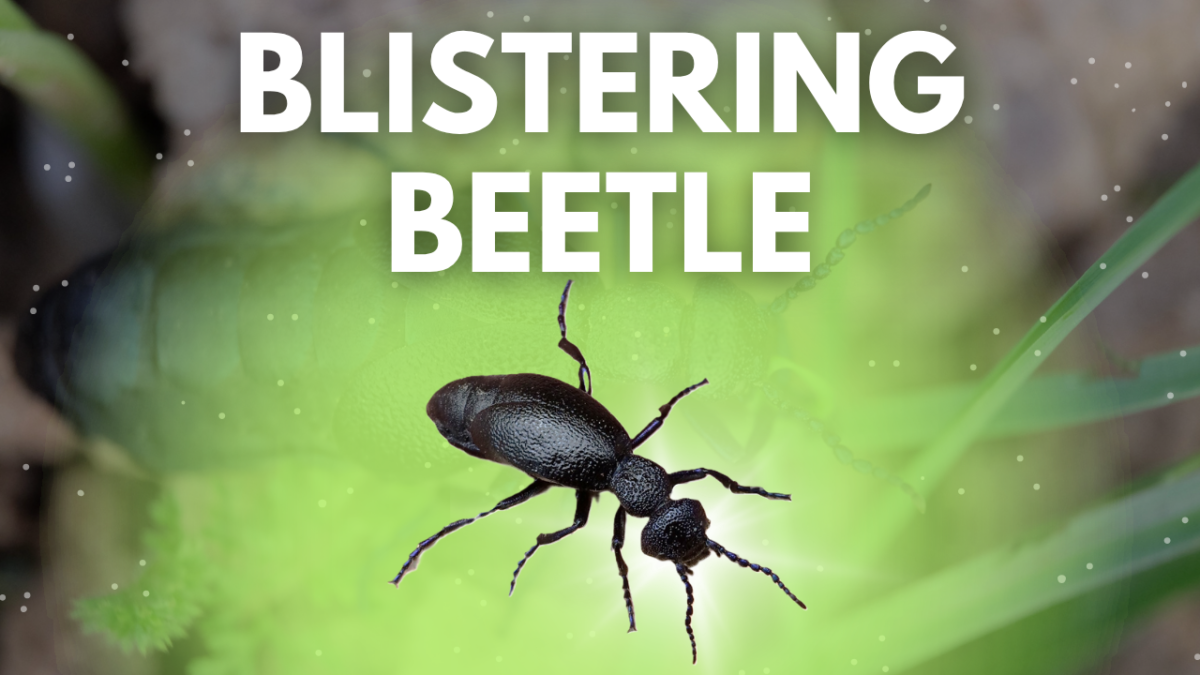
“…and today we’re talking about a blistering bug in the blistering heat of summer. More on that later.”
Some creatures kick in your front door. Others pick the lock, raid the fridge, and somehow convince you to thank them for stopping by. The European blister beetle belongs squarely in that second category. It’s a glossy black little ball that orchestrates one of nature’s sneakiest cons. But sometimes, working smarter rather than harder can look a lot more like freeloading like the European blister beetle here in Life, Death, and Taxonomy.
Description of the European Blister Beetle
- Shiny black body (sometimes with a blue-violet metallic sheen).
- It has a robust, elongated, somewhat cylindrical shape.
- The elytra (hardened forewings) are very short and do not cover the large, swollen abdomen, giving it a characteristic “waistcoat that won’t button up” look.
- It doesn’t have functional hind wings and cannot fly.
Measure Up
Welcome to the beloved Measure Up segment. The official listener’s favorite part of the show! The part of the show when we present the animal’s size and dimension in relatable terms through a quiz that’s fun for the whole family. It’s also the part of the show that’s introduced by you when you send in audio of yourself saying, singing, or chittering the words Measure Up into ldtaxonomy at gmail dot com.
Scott T sent in a Measure Up intro… he says it’s his 8 year old chittering…
Beetle Size
10–35 mm (roughly 0.4–1.4 inches) long
A family-owned grocery store in Prescott, Wisconsin — Ptacek’s IGA (p-TAH-check I-G-A) — set a new world record over Labor Day weekend in 2013 by grilling the world’s largest bratwurst. Producing a massive Budweiser beer bratwurst weighing 80 pounds. True or False – 1,309 beetles would go into the length of this labor day feast.
True. It was 152-foot, 9-inch (over 46 meters).
Triungulin Size
Their first instar is called a Triungulin and it’s about 1.5 mm (0.06 inches).
The Brandenburg Gate is Berlin’s most iconic landmark and one of Germany’s most significant historical monuments. It has a neoclassical design, modeled after the Propylaea on the Acropolis in Athens. True or False – 12,000 larvae go into the height of the Brandenburg Gate.
False. Brandenburg Gate is 26 meters (approximately 85 feet).
Fast Facts about the European Blister Beetle
It is native to Europe, found in meadows, field margins, warm open sites, heathlands, dry grasslands, and orchards. It occurs across most of the continent except the far north. In the UK, it is more common in the south and west (e.g., South West England and South Wales).
Blister beetles are a group of approximately 2,500 species worldwide, known for fun secretions…
These little squirts shoot out cantharidin (CAN-thar-ee-din), a potent blistering agent used as a chemical defense. Many species are aposematic…they use brightly colored and conspicuous looks to warn predators about their toxicity.
They undergo hypermetamorphosis, which means they go through several distinct larval stages before reaching adulthood.
Adults are active in spring and feed on plants (leaves and flowers).
Larvae are primarily insectivorous and even kleptoparasitic.
They are facultative parasitoids — which means they don’t even have to do it! They can survive on stored provisions alone and are not strictly dependent on harming a host.
Meloe proscarabaeus was named Insect of the Year 2020 in Germany, Austria, and Switzerland.
Major Fact: Smells Like Team Spirit
- The first-stage larvae, called triungulins, don’t immediately hunt for food—they wait patiently on flowers like tiny hitchhikers.
- Rather than simply looking like part of the flower, the larvae release a chemical cocktail that closely mimics the scent of female solitary bees.
- Male bees detect what they think is the perfume of a potential mate and eagerly investigate the “flower.”
- Instead of finding romance, the unlucky bee gets covered in dozens of microscopic stowaways clinging to its body.
- When the male eventually finds a real female and mates, the larvae transfer to her during the embrace, making this one of nature’s weirdest rideshare programs.
- The female bee unknowingly carries the larvae back to her nest while collecting pollen and nectar.
- Once inside the nest, the larvae feast on the bee’s stored pollen, nectar, and eventually the bee’s eggs or developing larvae.
- This strategy allows the blister beetle to bypass the difficult task of finding hidden underground bee nests on its own.
- By chemically impersonating a mate instead of physically resembling one, the larvae exploit the bees’ sense of smell—often their most important tool for finding partners.
- It’s an extraordinary example of chemical mimicry, proving that sometimes the best disguise isn’t what you look like—it’s what you smell like.
Ending
So find a flower you like, make your best smells, and bum a ride off a frienemy like the European Blister Beetle here in LDT.