“… and today we’re talking about a demolition ant. But more on that later.”
Out in the desert lives a tiny tan troublemaker that treats civil engineering like psychological warfare. These little insects spend their days bustling about deserts and grasslands looking for what seems like harmless debris. But beneath that innocent exterior is a six-legged strategist with the creativity of a medieval siege engineer. But sometimes it pays to play offense and defense at the same time in the game of life here in Life, Death, and Taxonomy.
Description of Conomyrma Ants
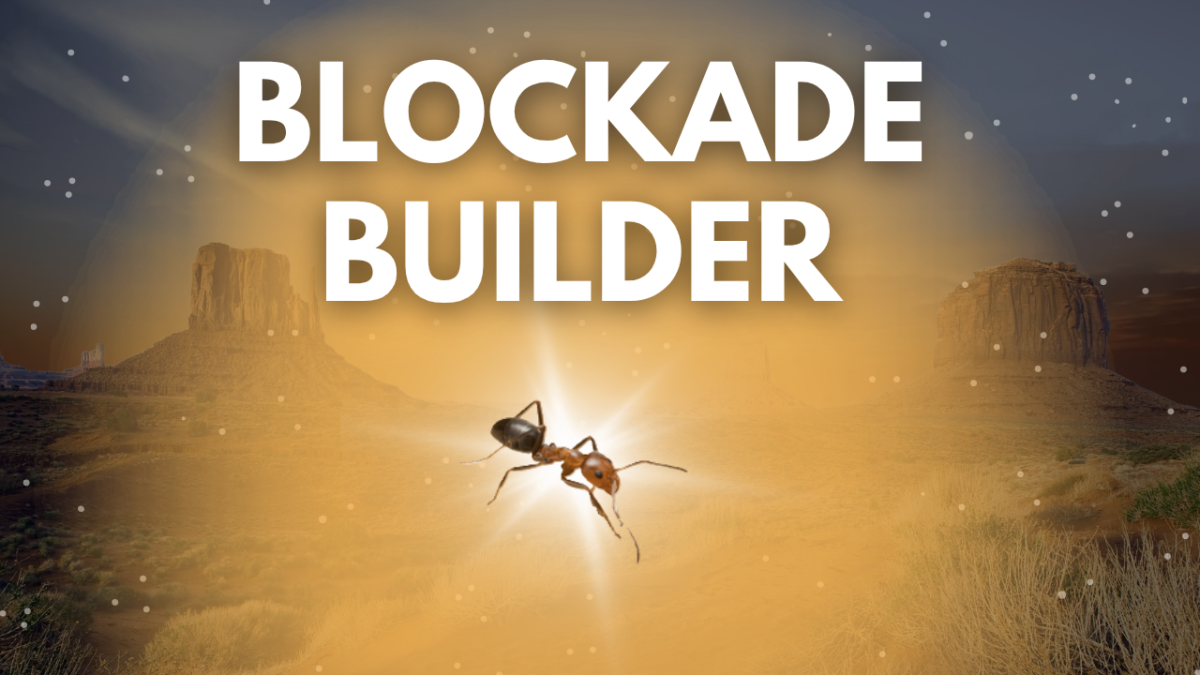
The name “bicolor” is well earned:
- Head, thorax, and waist: dark reddish-orange
- Abdomen (gaster): shiny black
- Length: workers are typically 3–5 mm (about ⅛–3⁄16 inch).
- Like other members of its genus, it has a distinctive little cone-shaped bump (the “pyramid”) on the back of its thorax.
Measure Up
Welcome to the beloved Measure Up segment. The official listener’s favorite part of the show! The part of the show when we present the animal’s size and dimension in relatable terms through a quiz that’s fun for the whole family. It’s also the part of the show that’s introduced by you when you send in audio of yourself saying, singing, or chittering the words Measure Up into ldtaxonomy at gmail dot com.
Atom Ant | Up and Atom | Boomerang Official
Workers: 3–5 mm (0.12–0.20 in)
Pueblo people lived in pueblos made of adobe bricks, which are made by pressing a mud mixture—often reinforced with straw—into wooden molds. After partially setting, the molds are removed, and the bricks are slowly dried, first flat and then on their edges, to minimize cracking. The same mud mixture, usually without straw, is used as mortar and wall plaster, with some cultures adding a lime-based coating to improve resistance to rain. True or false – 20 workers go into the length of an American adobe bricks.
Answer: False! American adobe bricks are about 25 × 36 cm (10 × 14 in).
Queens: about 6–8 mm (0.24–0.31 in)
The giant desert hairy scorpion is the largest scorpion in North America. Despite its size, its sting is about as painful and dangerous as a honey bee sting. True or false – 25 queen ants go into the length of this scorpion.
Answer: False! They can be up to 14 cm (5.5 in). Or 18 queen ants.
Fast Facts about Conomyrma Ants
Habitat
Dorymyrmex bicolor is found throughout the Americas, ranging from the southwestern United States (California, Arizona, New Mexico, Texas, and Oklahoma) through Mexico (including Baja California), into Central America (Belize, Guatemala, El Salvador, and Honduras), as far south as Peru, and even on several Caribbean islands, including Jamaica. Its broad range reflects its ability to thrive in hot, dry habitats across diverse regions.
These ants thrive where many other species struggle:
- Hot deserts
- Dry grasslands
- Disturbed soils
- Roadsides
- Sandy washes
Their nests are easy to recognize because the entrance is surrounded by a neat volcano-shaped crater made from fine sand. Colonies usually place these nests in full sun, where the soil becomes extremely hot.
Behavior
One of the most remarkable things about D. bicolor is that it is active during the hottest part of the day. While many desert ants retreat underground, these ants sprint across scorching sand in search of:
- dead insects
- live prey
- nectar
- honeydew produced by aphids and other sap-feeding insects
They’re incredibly quick and often appear to dart in erratic zigzags.
Colony life
- Colonies are often polygynous, meaning they can have multiple queens.
- Workers do not have specialized soldier castes.
- The ants rely on speed, recruitment, and chemical communication rather than powerful jaws or stings.
Major Fact: Here Hold This
- Rather than charging headfirst into battle, Conomyrma ants often collect tiny pebbles, bits of soil, and other debris and drop them into the entrances of rival ant colonies.
- This behavior partially blocks the enemy nest entrance, forcing the rival colony to waste precious workers digging themselves back out instead of foraging for food.
- The tactic is especially useful when competing with neighboring colonies over valuable food sources or territory.
- Workers carefully carry individual pebbles that are appropriately sized for the nest entrance—large enough to be annoying but small enough to transport efficiently.
- Some colonies repeatedly return with more debris, slowly burying the entrance a little at a time rather than trying to seal it all at once.
- By clogging traffic at the front door, they reduce the number of rival workers that can leave to defend resources.
- The strategy minimizes direct combat, reducing injuries and deaths among the attacking ants while still weakening the competition.
- Once the opposing colony is occupied with excavation duty, Conomyrma workers can gather food with far less interference.
- Researchers consider this a form of indirect competition—winning the contest without engaging in an all-out brawl whenever possible.
- It’s essentially the insect equivalent of parking a dump truck in front of your rival’s driveway. Technically nobody threw a punch, but everybody knows who started it.
Ending
So live life in technicolor, use the environment to your advantage, and use medieval siege tactics to passive aggressively block your neighbor’s door shut like the conomyrma ant here in LDT.