
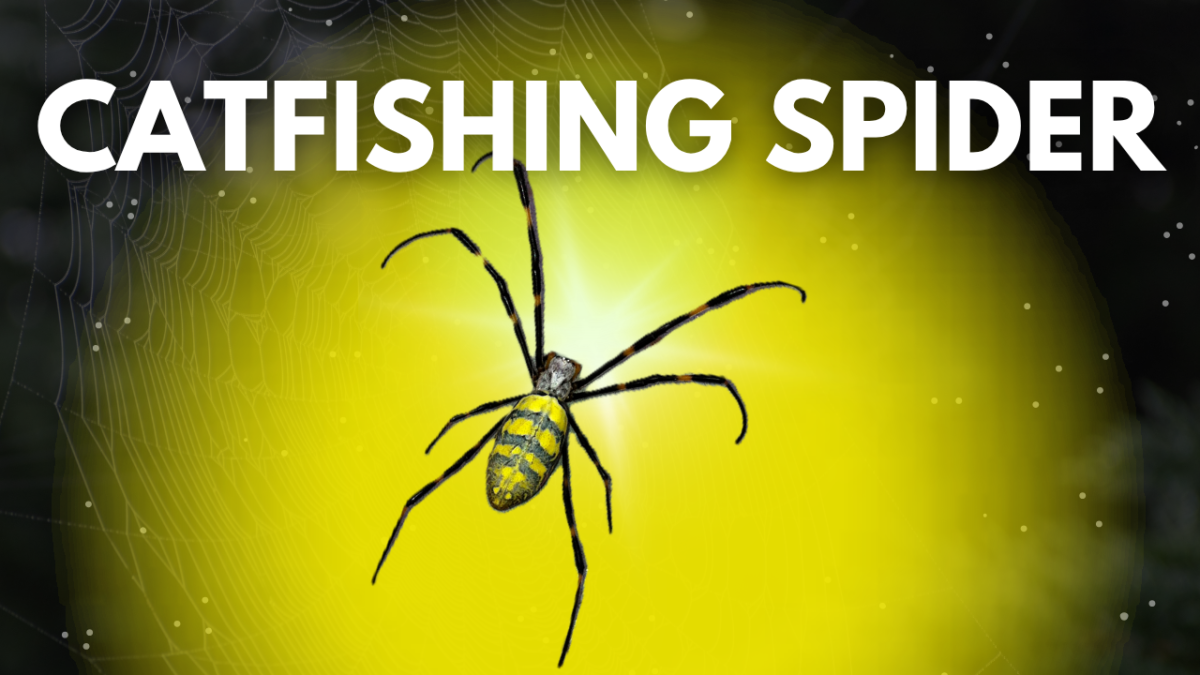
“…and today we’re talking about a sophisticated chemist. But more on that later.”
In moonlit meadows and forest edges, there lurks a patient puppeteer. While most predators settle for catching dinner, a sort of “earn it and burn it” approach, the East Asian orb-weaver seems oddly interested in what its victims do after they’re caught, treating them sort of like seed money for an investment. Somewhere between a mustache-twisting villain and a shrewd businessman, this advanced arachnid shows that it pays to work smarter rather than harder to survive here in Life, Death, and Taxonomy.
Description of the East-Asian Orb Weaver
- Medium-sized orb-weaving spider with a sturdy body and rounded abdomen.
- Usually colored brown, black, or gray, helping it blend into bark, leaves, and other natural surfaces.
- Has eight eyes and long, spiny legs adapted for moving across its web.
- Females are larger and more robust than males, which are smaller and slimmer.
Measure Up
Welcome to the beloved Measure Up segment. The official listener’s favorite part of the show! The part of the show when we present the animal’s size and dimension in relatable terms through a quiz that’s fun for the whole family. It’s also the part of the show that’s introduced by you when you send in audio of yourself saying, singing, or chittering the words Measure Up into ldtaxonomy at gmail dot com.
Charlotte’s Web (3/10) Movie CLIP – Wilbur Meets Charlotte (2006) HD
Females: about 10–20 mm (0.4–0.8 in) in body length, occasionally larger.
Taipei 101 is the tallest building in Taipei, Taiwan. It was completed in 2004, making it the world’s tallest building until surpassed by the Burj Khalifa in 2010. True or False – 35,405 spiders go into the height of Taipei 101.
Taipei 101 is 508.2 meters (1,667 feet) and currently 11th on the leaderboards.
Males: about 5–10 mm (0.2–0.4 in) in body length.
The orb-weaver is eaten by birds like the Brown-eared Bulbul, Japanese White-eye, and Eurasian Wren. True or False – A Eurasian Wren would need to eat 17 spiders to eat its wingspan in orb weavers.
A eurasian wren’s wingspan is 7 inches.
Fast Facts about the East-Asian Orb Weaver
The East Asian orb-weaver, Araneus ventricosus, is a large, colorful orb-weaving spider found across eastern Asia, including China, Japan, Korea, and parts of Taiwan.
It’s an orb-weaver, which means it spins the classic circular “wheel” web. Usually built in vegetation between branches, shrubs, or garden plants. Webs are often rebuilt every night. Webs can exceed 50 cm (20 inches) in diameter.
The spider typically waits in the center of the web at night, monitoring vibrations that signal trapped prey.
It feeds on a variety of flying insects, including:
- Moths
- Flies
- Mosquitoes
- Beetles
- Small wasps
During autumn, males search for females and cautiously approach their webs. This is a dangerous time for the male—if he is mistaken for prey or simply unwelcome, he may be eaten.
Females produce egg sacs containing hundreds of eggs. The spiderlings hatch later and disperse, often by “ballooning,” releasing silk threads that allow the wind to carry them away.
They are not dangerous to humans. Its venom is so specialized to hunting its bug prey that it’s ineffective in vertebrates.
Researchers analyzed the venom of the East Asian orb-weaver (Araneus ventricosus) and found that it is packed with peptides, proteins, and enzymes specifically adapted for subduing insect prey. But even in higher concentrations it had no effect on nerve or muscle function in rats and mice, and injected mice showed no symptoms of envenomation.
Major Fact: Catfishing in Morse Code
If the firefly lanterns were obscured with ink and did not flicker, the spiders ate the insects right away.
The East Asian orb-weaver captures both male and female fireflies in its web, but it treats them very differently.
Female fireflies are usually eaten immediately because they don’t contribute much to the spider’s unusual strategy.
When a male firefly is captured, the spider often keeps it alive rather than consuming it right away.
The spider manipulates the trapped male by biting it and altering its behavior through chemical influence.
Under normal circumstances, a male firefly flashes a species-specific courtship signal to attract females.
After the spider intervenes, the male begins producing flash patterns that more closely resemble those of receptive females.
Other male fireflies interpret these altered flashes as an invitation to mate and fly toward the signal source.
The incoming males become trapped in the orb web, effectively turning one captured firefly into a living lure for additional prey.
This strategy allows the spider to catch significantly more prey than it could by relying solely on the passive capture abilities of its web.
Researchers have observed that the spider appears capable of inducing different flash patterns depending on the firefly species involved, suggesting a remarkably specialized form of behavioral manipulation.