
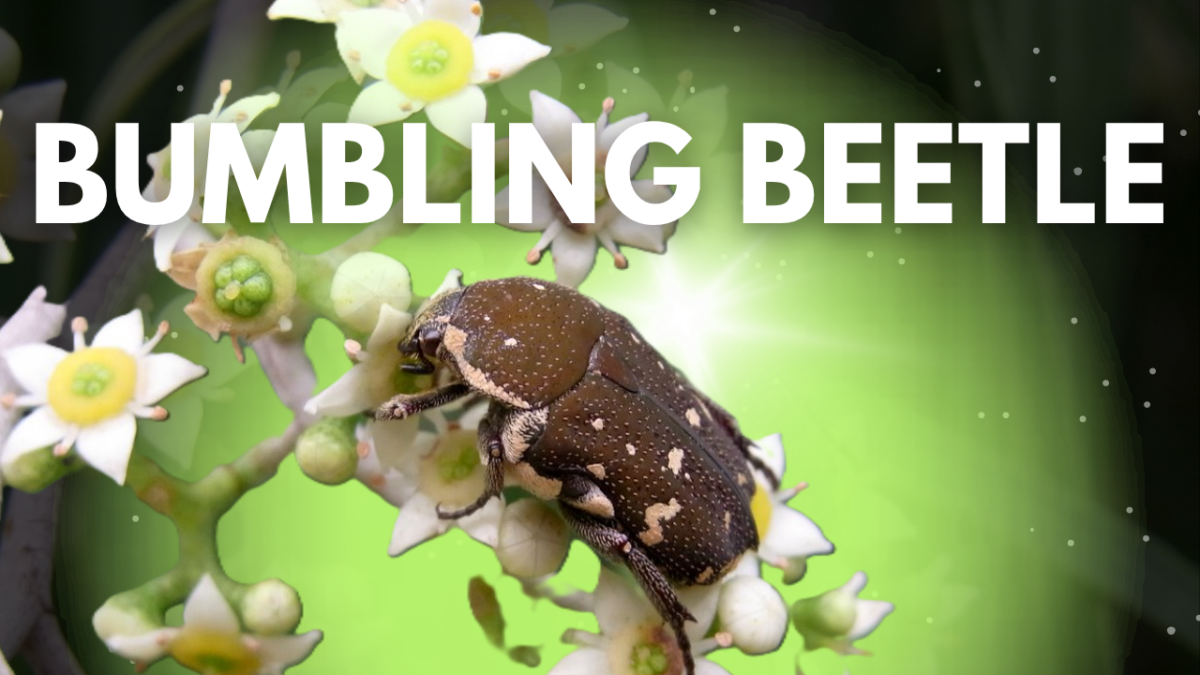
“…and today we’re talking about a bumbling beetle, but more on that later.”
A bee is a brilliant bug… essential to the natural order. Plants propagate with the help of these fuzzy friends… not just wild flowers, but all the plants we need to survive in a healthy ecosystem. But what happens when a beetle comes a-bumbling. The brown flower beetle shows us what happens when finesse is thrown out the window in the pollination game in Life, Death, and Taxonomy.
Description of the Brown Flower Beetle
- Looks like someone crossed a June bug with a bumblebee and then let nature’s paint department go a little wild.
- Compact oval-shaped beetle with a chunky, armored body.
- Usually dark brown to chocolate brown with creamy white spots and squiggles scattered across its wing covers.
- Covered in fine hairs that help give it a fuzzy, almost bee-like appearance.
- Has six sturdy legs equipped with tiny claws for hanging onto flowers during what appears to be an all-day brunch.
- Broad, shovel-like head with short antennae ending in small fan-shaped clubs.
- Medium-sized for a flower chafer beetle—large enough to notice on a flower but small enough to lose in a bouquet.
- The hard wing covers look polished, like somebody waxed a tiny armored personnel carrier.
Measure Up
Welcome to the beloved Measure Up segment. The official listener’s favorite part of the show! The part of the show when we present the animal’s size and dimension in relatable terms through a quiz that’s fun for the whole family. It’s also the part of the show that’s introduced by you when you send in audio of yourself saying, singing, or chittering the words Measure Up into ldtaxonomy at gmail dot com.
Heracross annoying Bulbasaur compilation😱😱😖
Length
Adult beetles are 8–11 mm long
Heracross is a fictional pokemon based on a goliath beetle, but it likes to try to drink nectar from Bulbasor apparently… True or False– 103 brown flower beetles go into the height of a Heracross
Heracross is 1.5 m (4’11”)
Grub Length
The length of grubs in the Cetoniinae subfamily are around 25 to 50 mm. Some species have larvae that are larger than adult beetles.
Gamer Grub was a performance snack mix formulated specifically for gamers, marketed as a cleaner, nutrient-enhanced alternative to traditional gaming snacks. It was an essential trail mix made of dry ingredients that limit dust and oils that might get on your hands. It was discontinued… one Reditor said it was intended for hardcore gamers QUOTE “a group which usually has little buying power.” True or False – 5 Cetoniinae grubs go into the height of a bag of Gamer Grub.
A pack was 6 x 4.25 inches
Fast Facts about the Brown Flower Beetle
- Primary Fact: Unlike many beetles that accidentally pollinate while bumbling around, this species is a regular flower visitor and an important pollinator of many wildflowers throughout its range.
- Range: Found across much of Europe, including the United Kingdom, France, Germany, Scandinavia, and parts of Eastern Europe.
- Habitat: Prefers woodlands, forest edges, meadows, gardens, orchards, and any place where flowers are.
- Diet: Adults feed on nectar, pollen, flower parts, and sugary plant juices.
- Baby Food: Larvae live in decaying wood and rotten plant material where they help recycle nutrients back into the ecosystem.
- Romance: Mating usually occurs during the warm months when adults gather on flowering plants. Nothing says romance quite like meeting over a shared flower.
- Social Life: Not truly social, but dozens may gather on especially productive flower patches.
- Flight: Strong, noisy fliers that can zip between flowers with surprising speed for something that looks like a flying chocolate-covered almond.
- Predators: Birds, spiders, lizards, small mammals, and predatory insects all consider flower beetles a convenient snack.
- Sounds: Produces a noticeable buzzing sound in flight that often causes people to mistake it for a bee.
- Defense Strategy: Relies heavily on camouflage, quick flight, and its tough exoskeleton rather than stingers, venom, or speed.
- Lifespan: Most of the life cycle is spent as a larva in rotting wood; adults typically live only a few weeks to a couple of months.
- Fun Fact: Flower chafers can partially deploy their wings from beneath their wing covers without fully opening them, allowing for surprisingly quick takeoffs.
Major Fact: Non-Bee Bumbling
The Brown Flower Beetle is what is known as a flower chafer–a beetle that enjoys pollen.
Beetle pollination—known as cantharophily—is thought to be one of the earliest forms of insect pollination. Flower chafers like Glycyphana glycyphana belong to a lineage that has been interacting with flowering plants long before bees figured it out.
But just because you’re first doesn’t mean you are the best.
They are called “mess and soil” pollinators… a colloquial nickname for certain pollinators (mostly beetles) that do transfer pollen but do so in a clumsy, destructive, and untidy way compared to “refined” pollinators like bees or butterflies.
They might also chew through petals, leaves, and other floral parts, often leaving holes, bits of plant debris, damage and even droppings behind.
Unlike bees, which actively collect pollen and often have specialized structures for carrying it, the Brown Flower Beetle is a haphazard pollinator. It visits flowers mainly to feed on pollen, nectar, and sometimes floral tissues.
As it crawls around inside blossoms, pollen grains stick to the hairs on its body and legs. When it flies to another flower, some of that pollen rubs off onto the next plant’s reproductive structures.
Its hairy body is important. The fine hairs (chitin) increase the surface area available for pollen to cling to, much like the fuzz on a bee. Although it isn’t nearly as efficient as a honeybee or bumblebee on a per-visit basis, it can still transfer substantial amounts of pollen because it spends so much time moving around inside flowers.
Bee eyes are designed to find flowers but research also shows that these beetles are capable of some level of color-vision, which is important for identifying flowers against a green plant backdrop while flying around in a meadow.
Flower chafer beetles are supplemental to bees in terms of pollinating… but they do provide a service that bees don’t: they make plants tougher.
Plants pollinated by beetles adapt to their rough ways with:
- Thick, leathery petals and leaves to withstand the chewing.
- Strong scents (often fruity, spicy, musky, or fermented) rather than relying only on bright colors.
- Bowl-shaped or open flowers that are easy to access.
Examples: Magnolias, spicebush, and many primitive flowering plants.
Ending
So lap up that sugary nectar, get your lady some flowers, and become a clumsy part of the plants’ reproductive cycle like the brown flower beetle here in LDT.