
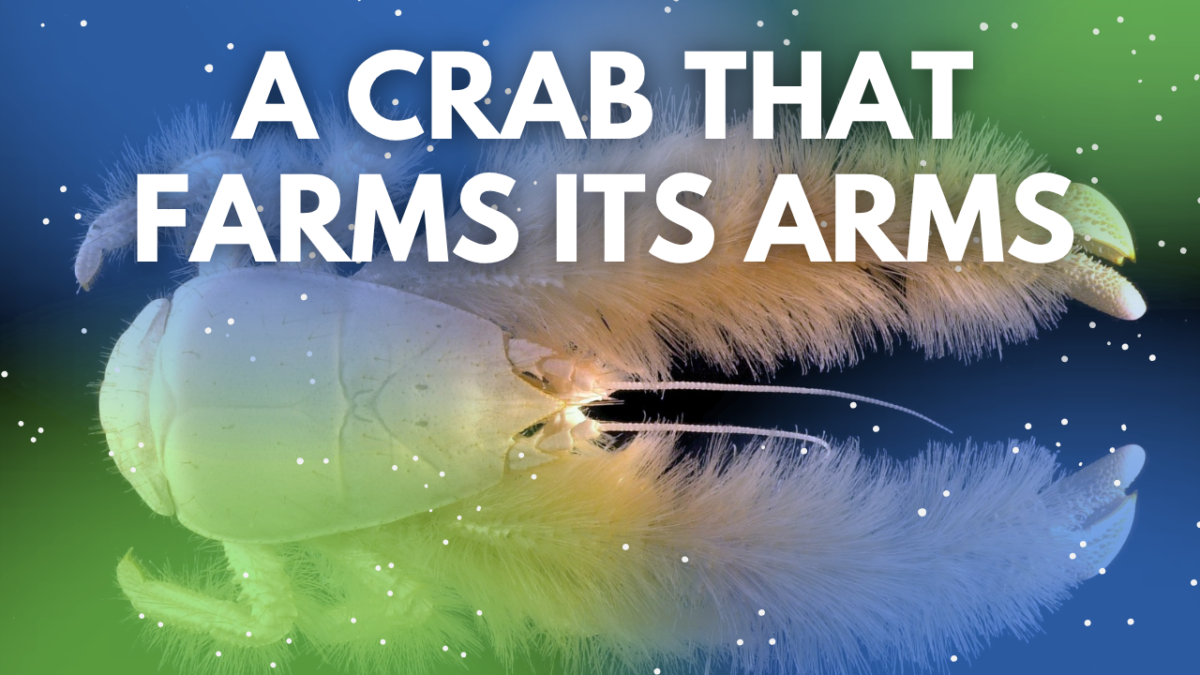
A crab is draped in armor, but can a warrior become a farmer? Is it a battle he takes up arms for or can arms help him farm more? The Yeti crab is a deep sea crustacean that’s turned his swords to plowshares… but that doesn’t mean he’s not ready for a fight. It’s always better to be a warrior in a garden in Life, Death, and Taxonomy.
Thank you to Daniel White for the use of his song “Make Pangea Unified Again.” To hear more of Daniel’s music please visit Youtube dot com slash @DanielWhiteArtist.
Description of the Yeti Crab
- Looks like a small lobster crossed with a yeti who got lost on the ocean floor
- Creamy white to pale yellow body, with a lighter-colored shell and long, spindly legs
- Covered in fine, silky-looking bristles, especially on its oversized front claws
- Has a flattened body, a small head, and a pair of dark, bead-like eyes that are reduced in size
- Sports long, slender walking legs that make it look like it’s permanently reaching for something on a very high shelf
- Its furry appearance is so unusual that it looks more like a plush toy than a crustacean you’d expect to find thousands of feet underwater
Measure Up
Welcome to the beloved Measure Up segment. The official listener’s part of the show! The part of the show when we present the animal’s size and dimension in relatable terms through a quiz that’s fun for the whole family. It’s also the part of the show that’s introduced by you when you send in audio of yourself saying, singing, or chittering the words Measure Up into ldtaxonomy at gmail dot com.
Bumble the Abominable Snow Monster ‘roar’ demonstration
Length
15 cm (5.9 in) long
Deep sea mining means extracting minerals from the deep ocean floor. The main target is polymetallic nodules on the abyssal plain. The Clarion–Clipperton zone in the Pacific between Hawaii and Mexico alone holds over 21 billion tons of them. True or False – 40,037 crabs go into the mining depth of polymetallic nodules in the Clarion–Clipperton zone.
True. Polymetallic nodules are found 4 to 6 km (19,685 feet) down on the abyssal plain.
Depths
2,200 metres (7,200 ft)
Clipperton Atoll is an uninhabited French coral atoll in the eastern Pacific, about 457 nautical miles from the Clarion–Clipperton zone mining area. It’s home to mostly birds including the brown boobies and masked boobies. In fact, it’s home to the largest masked booby colony on Earth. True or False – the Yeti crab lives 1,375 masked-booby wingspans below the surface.
True. 1,375 masked-booby wingspans.
Fast Facts about the Yeti Crab
- Range: Found in the South Pacific Ocean along the Pacific-Antarctic Ridge, approximately 930 miles south of Easter Island. Its known habitat is extremely remote, making it a real-life deep-sea cryptid.
- Habitat: Lives around deep-sea hydrothermal vents at depths of approximately 7,200–7,300 feet. These vents release mineral-rich, superheated water into the surrounding ocean, creating unusual little oases of life in the deep-sea darkness.
- Diet: Likely an omnivore, with bacteria providing an important food source. It has also been observed eating damaged mussel tissue, so it isn’t above scavenging a little seafood buffet.
- Behavior: Has reduced, pigment-free eyes and is thought to be effectively blind. When your home is thousands of feet underwater in perpetual darkness, vision isn’t exactly the hottest evolutionary upgrade.
- Discovery: First discovered in 2005 by scientists exploring the Pacific-Antarctic Ridge using the research submersible Alvin. The discovery was announced in 2006, proving that the deep ocean still has plenty of weird surprises in stock.
- Family tree: Despite the name, it’s not a true crab or a lobster in the everyday sense. It’s a squat lobster in the infraorder Anomura, a group that also includes hermit crabs.
- Reproduction: Females carry their eggs attached beneath their abdomen until they hatch. Scientists still know relatively little about the species’ full reproductive cycle and early development.
- Social life: Unlike some other yeti crab species that form enormous crowds around deep-sea vents, Kiwa hirsuta has been observed at relatively low densities.
- Predators: Its natural predators are not well documented. Potential threats include other deep-sea predators, but identifying which animals regularly hunt this particular species remains a challenge.
Major Fact: Old MacDonald and the Sea
Yeti crabs are farmers… farming bacteria on their own arms as their primary food source…
It ain’t much but it’s honest work…
Yeti crabs are blind, so finding food by sight is out of the question. But what they lack in vision, they make up for in arm hairiness. Technically it’s not hair… Its dense silky setae.
When they were first discovered. Scientists were puzzled by their slow, rhythmic claw-waving. They seemed to raise the roof with intention. Chemical analysis of the crabs’ tissues and the bacteria on their silky arms showed the crabs were teaming with bacteria… bacteria that are also delicious to a crab.
Submarine video revealed they harvest the bacteria using specialized hairy mouthparts that scrape the slurry of sea sludge off their arms. The claw-waving appears to fan nutrients over the bacteria, fertilizing the crop, ensuring a bountiful harvest.
In a 2008 study, a team used electron microscopy to examine how the bacteria attach to the setae, molecular phylogenetic analysis (16S rRNA sequencing) to identify which bacteria are present. Electron microscopy showed dense bacterial clusters anchored directly to the chitinous outer layer of the setae. Notably, there were no specialized host structures for attachment — the bacteria just grip the hair surface itself.
The dense microflora on the crab’s setae has the potential to fix carbon and cycle reduced and oxidized sulfur. In plain terms, the “fur” is a living farm of chemosynthetic bacteria that can turn vent chemicals into energy.
While other deep-sea animals had been found with bacteria growing on them, this was the first clear evidence of a deep-sea animal actively farming its bacteria. Researchers note this highlights how little is known about the deep sea and the potential for more discoveries as exploration expands.
Ending
So pick your friends carefully, enjoy the warmth of a deep-sea thermal vent, and farm the choicest bacteria on your unkempt arms like the yeti crab here in LDT.