
“…and today we’re talking about a grumpy gus with a whimsical name. But more on that later.”
There are lots of defensive options in the animal kingdom. Camouflage helps you blend in, speed helps you escape, and horns help you fight off predators. But down where it’s wetter, there’s a few that are better. The northern stargazer is a fish with an enchanting name who couldn’t decide between two amazing defense mechanisms, so it became the swiss army knife of Life, Death, and Taxonomy.
Thank you to Daniel White for the use of his song “Make Pangea Unified Again.” To hear more of Daniel’s music please visit Youtube dot com slash @ DanielWhiteArtist.
Description of the Northern Stargazer
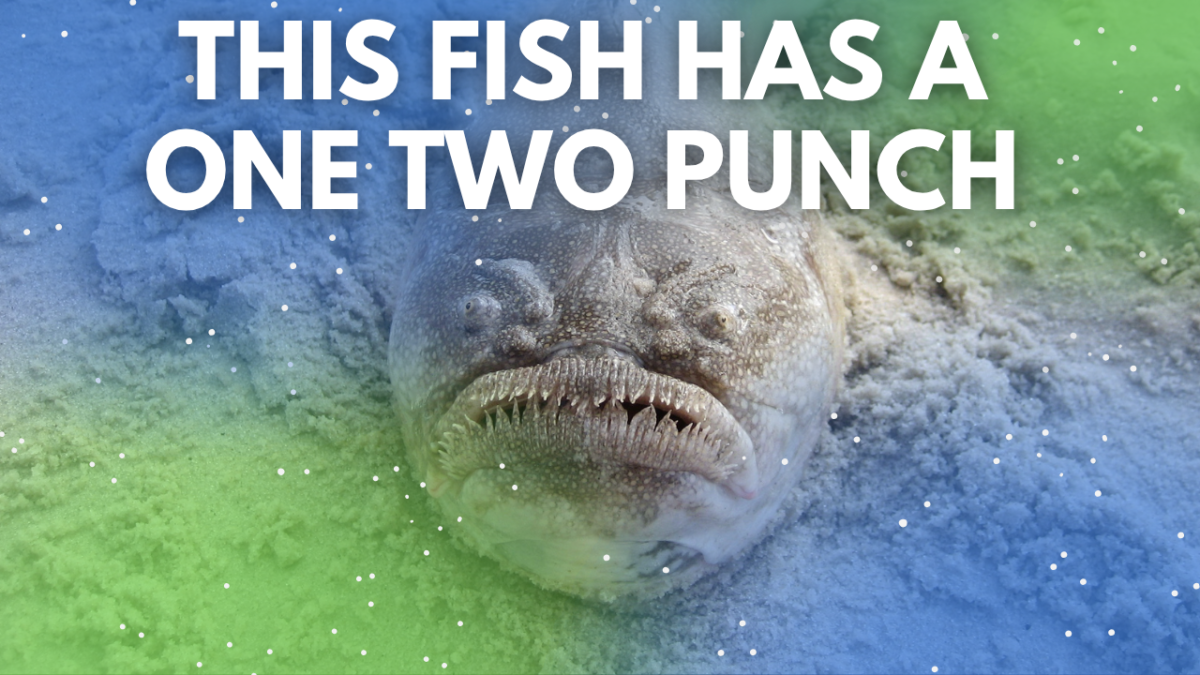
- Looks like an angry totem deity face taped to the top of a catfish
- Has a chunky, broad head and a tapered body that narrows toward the tail.
- Sometimes has these comma/crescent-shaped eyes which in anime means you’ve killed a family member for extra spirit power or something.
- Usually brownish, grayish, or olive-colored on top, with pale spots scattered across its body.
- Its underside is lighter, helping it blend into the sandy ocean floor.
- Small, rough-looking scales cover its body, giving it a somewhat pebbly appearance.
- Its eyes sit on the top of its head in a menacing but vacant expression
- Its mouth is large and angled upward, positioned perfectly for ambushing prey swimming overhead.
- Has a pair of pectoral fins near its head and a long dorsal fin running along its back.
Measure Up
Welcome to the beloved Measure Up segment. The official listener’s favorite part of the show! The part of the show when we present the animal’s size and dimension in relatable terms through a quiz that’s fun for the whole family. It’s also the part of the show that’s introduced by you when you send in audio of yourself saying, singing, or chittering the words Measure Up into ldtaxonomy at gmail dot com.
Length
Usual adult size 8–18 inches; specimens to about 22 inches reported.
Brown Bess Bayonet is a socket bayonet used in the Revolutionary War. Socket bayonets is a long, triangular blade attached to a hollow metal sleeve, the socket. True or false – a Brown Bess Bayonet is the same length as a Northern Stargazer.
True.
Weight
Some claims of specimens up to 20 pounds.
The Atlantic horseshoe crab is a marine and brackish chelicerate arthropod often called the living fossil because you can find its grandpas far back in the fossil records relatively unchanged. True or false – an Atlantic horseshoe crab is the same weight as a Northern Stargazer.
False. They weigh up to 4.5 kg (10 pounds).
Fast Facts about the Northern Stargazer
Range: Found along the western Atlantic coast of the United States, from New York to North Carolina. It also occurs in the Chesapeake Bay and nearby coastal waters.
Habitat: A bottom-dwelling fish that prefers sandy or pebbly ocean floors, typically in coastal waters and at depths reaching around 120 feet. It can bury itself almost completely in the sediment, leaving its eyes and nostrils exposed.
Diet: Eats small fish, crabs, and other crustaceans. Basically, anything small enough to fit in its mouth might become an unsolicited part of the menu.
Hunting: An ambush predator that waits beneath the sand for an unsuspecting snack to swim by, then lunges and sucks it into its large mouth. Its electrical organs are primarily defensive rather than tools for capturing prey.
Reproduction: Spawning generally occurs in late spring and early summer. Eggs are released into the water, and the larvae initially look very different from adults, with eyes on the sides of their heads that gradually migrate upward as they develop.
Breathing: Its nostrils are positioned on top of its head, allowing it to draw in water while most of its body remains buried. Special fringed structures around the nostrils help keep sand out.
Social behavior: Northern stargazers are generally solitary ambush predators rather than schooling fish. Their buried-and-waiting lifestyle doesn’t exactly lend itself to group activities.
Lifespan: A reliable, species-specific lifespan estimate is difficult to establish. Estimates of roughly 5–10 years based on related stargazers should be treated cautiously.
Predators: Larger predatory fish may eat stargazers, particularly younger individuals. Their camouflage, electric discharge, and venom-associated spine help make them a less appealing meal.
Major Fact: One Two Punch
Sea creatures develop one of many interesting defense mechanisms. Some are venomous. Some even emit an electrical charge. The Northern Stargazer says, “Por que no los dos?”
The northern stargazer is venomous AND electric.
Venomous spines
Two large venomous spines sit above the pectoral fins. These spines provide a defensive mechanism against threats when the fish is buried or exposed
Humans are often stung by the fish. It sits buried beneath the sand and can be stepped on or brushed against accidently. It also plagues fishermen. The sting is painful, causing sharp pain, swelling, redness, usually 4 to 12 hours and is treated with hot-water immersion and over-the-counter pain relief. But it’s rarely fatal to people.
What’s the venom made of? We don’t know. A 2023 Frontiers in Marine Science review, said the venoms were QUOTE “heat-labile, mucous-accessible, and difficult to extract” and that the venom glands “usually do not have a well-defined storage structure.” No definitive look at the venom has ever been done. By comparison, stonefish venom is fully characterized.
Amateur hands-on research is discouraged. Keep your hands off these spines.
Electric organ
A paired electric organ sits behind each eye, made of about 200 thin layers of electric tissue, made of specialized cells called electrocytes. Muscle cells that gave up contracting and became batteries instead.
In Astroscopus, the organ derives from modified eye muscles. Delivers a shock widely reported as up to 50 volts — unpleasant and startling, not dangerous to humans. The shock may not be powerful enough to stun prey but it’s believed to threaten predators that approach from above….
Stargazers are unique among electric fish in having NO electroreceptors. They cannot electrolocate. The shock is purely a weapon, not a sense. Stargazers represent one of eight independent evolutions of bioelectrogenesis.
Ambush and the vacuum mouth
Funny enough, it doesn’t need either for hunting. It buries itself in sand or mud using side-to-side motions of its ventral fins and tail until only eyes and mouth poke out. Strikes upward and sucks prey in with a vacuum created by the large mouth.
Ending
So nestle in the sand, stab and shock your enemies, and always look at the staaaaars like the Northern Stargazer