“…and today we’re talking about the familiar of a ferocious female. But more on that later.”
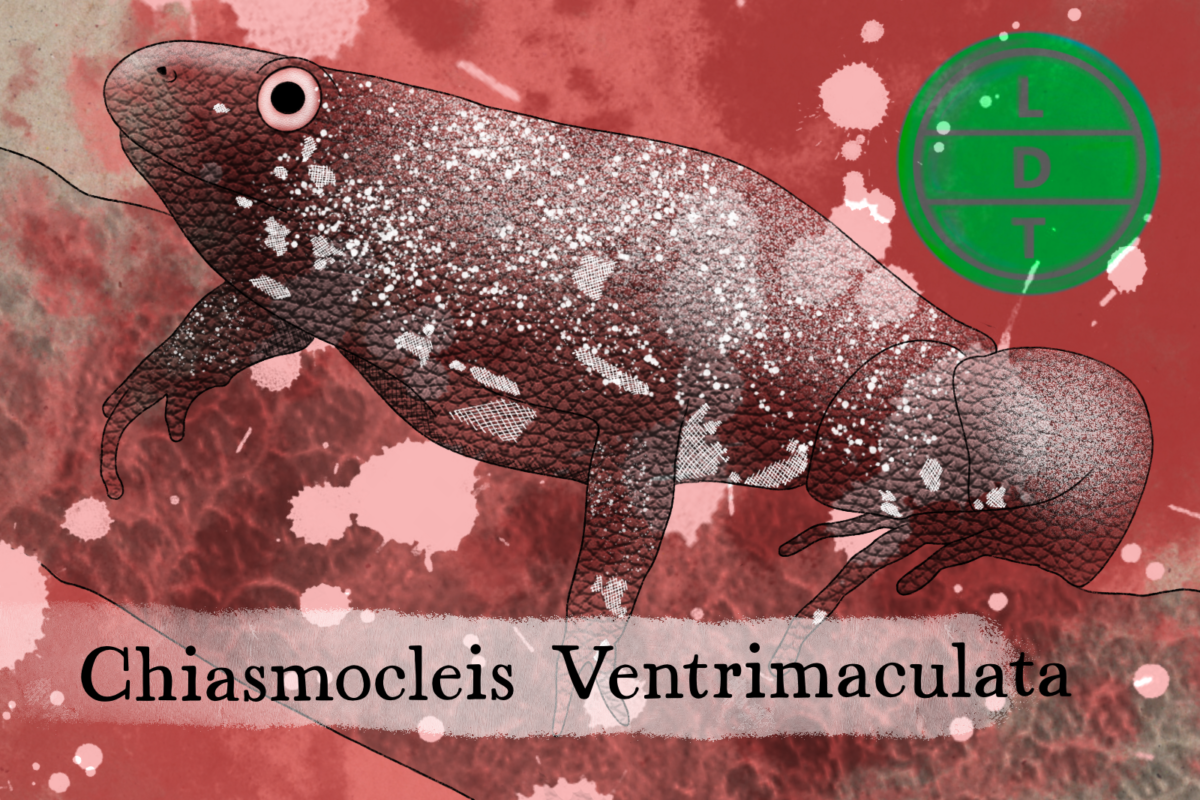
The life of a pet is a charmed one–at least when your owner is a kind and benevolent ruler. But what if you lived in the home of a giant arachnid, ten times your size. Would you still want belly rubs and walks in the park? Such is the life of the dotted humming frog. But sometimes a large and scary defender is not something you can afford to turn away in Life, Death, and Taxonomy.
Measure Up
Welcome to the beloved Measure Up segment. The official listener’s favorite part of the show! The part of the show when we present the animal’s size and dimension in relatable terms through a quiz that’s fun for the whole family. It’s also the part of the show that’s introduced by you when you send in audio of yourself saying, singing, or chittering the words Measure Up into ldtaxonomy at gmail dot com. We don’t have a new Measure Up intro!
Length
- 0.7 inches (2 cm)
- How many dotted humming frogs go into the length of a direhorse on Pandora?
- Hint: The direhorse is the fictional animal from the Avatar universe. It is essentially an ugly horse that sounds exactly like the raptors from Jurassic Park 3.
- 240 frogs. The big horse is 14 feet long.
Tadpole Length
- 0.6 inches (17 mm)
- How many tadpoles go into the length that Pattrick Mahomes threw for in the 2023 Super Bowl against the Philadelphia Eagles.
- Hint: Mahomes completed 21 of the 27 passes for three touchdowns and no interceptions. He also ran for 44 yards despite an ankle injury.
- 10,920 frogs. Mahomes threw for 182 yards.
Major Fact: Friends in Low Places
The dotted humming frog is the pet of a much bigger spider.
These small frogs have a commensal, if not mutualistic, relationship with big hairy tarantulas. Researchers have observed the frogs living in the burrows of colombian lesser black tarantulas.
But they aren’t just like muskrats that find their way into beaver dams. These frogs have been observed darting away from danger, not just into spider holes, but underneath the tarantulas themselves.
Black tarantula females fiercely guard their burrows to protect their young. Frogs in those burrows have a guard that can take on other insects, small mammals, and snakes that would make a meal out of small frogs.
The frogs rarely leave the burrows unless the tarantula ventures out first.
But why don’t these protective tarantulas eat these tiny green morsels?
They have been observed investigating and picking up the frogs, but quickly spitting them out or dropping them. It’s thought that this particular species is poisonous or distasteful to tarantulas. The spiders were also tested to see if they don’t eat frogs in general, but other species of frogs made fine meals.
So if the frogs get protection and the tarantulas get nothing in return, that is called commensalism. But some researchers think the situation might be more mutually beneficial.
Why would an aggressively protective spider tolerate a freeloader, even if they can’t eat them?
It is theorized that frogs are to spiders as cats are to us. They may serve to keep the place clear of pests.
Frogs eat small insects that might pose a threat to spider eggs. While the spider defends the nest from large things, the frogs eat up any small vermin the spider might overlook.