
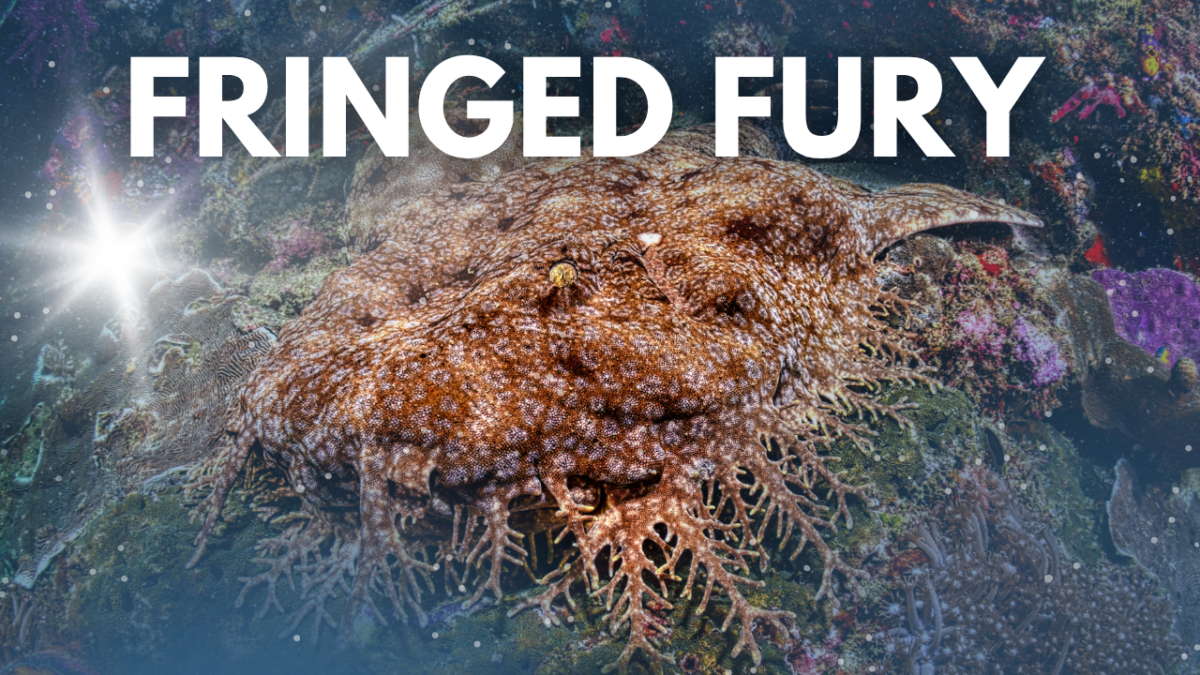
“…and today we’re talking about a sea rug that expresses deep sorrow and wretchedness, but more on that later.”
The 70s and your average coral reef have one thing in common: shag carpets are a bad idea. In either case, you need to watch where you step, because you never know what lurks underneath. The Tasselled Wobbegong spends most of its day pretending to be nothing but an unkempt rug. While most sharks waste their energy spinning their wheels and chasing after their meals, ol’ TW likes to do things the lazy way. It’s the crocodile of the reef, an ambush predator with a ridiculous amount of long-suffering. But sometimes the deadliest strategy isn’t constant effort—it’s explosive patience like the Tasselled Wobbegong here in Life, Death, and Taxonomy.
Description of the Tasselled Wobbegong
It looks like a melted shark… If you’re picturing a shark, stop.
- The tasselled wobbegong is a broad, flattened carpet shark.
- Its wide head is lined with branching, tassel-like skin flaps that form a fringe around the snout and a beard beneath the chin, helping it blend into the seafloor.
- It has a large mouth positioned near the front of its head, long fang-like front teeth, and large rounded pectoral and pelvic fins.
- Its gray- or yellow-brown body is covered in a complex mosaic of dark blotches and lines that provide excellent camouflage against coral reefs.
Measure Up
Welcome to the beloved Measure Up segment. The official listener’s favorite part of the show! The part of the show when we present the animal’s size and dimension in relatable terms through a quiz that’s fun for the whole family. It’s also the part of the show that’s introduced by you when you send in audio of yourself saying, singing, or chittering the words Measure Up into ldtaxonomy at gmail dot com.
Length
1.8 meters (5.9 feet) long
The Aru flying fox is a large fruit bat native to Indonesia’s Aru Islands. It is one of the world’s least-known flying foxes and is currently classified as Critically Endangered with no confirmed sightings since 1877. True or False – 9.4 aru flying fox forearms goes into the length of a Tasslled Wobbegong.
True. The forearm is 190–191 mm (7.5 in) long.
Depth
50 m (160 ft) deep
South Pole–Aitken basin is the deepest and largest impact crater on the Moon, and one of the largest in the entire Solar System. True or false – 160 lengths of wobbegong living depths go into the depth of this crater.
False. 168. It’s between 6.2 and 8.2 km (3.9–5.1 mi) deep.
Fast Facts about the Tasselled Wobbegong
The tasselled wobbegong is found on coral reefs across northern Australia, New Guinea, Waigeo, and the Aru Islands, though reports from Malaysia remain unconfirmed.
It is a common bottom-dwelling shark that lives almost exclusively on coral reefs. It is most often seen resting in reef channels, along reef faces, or on top of coral formations.
At night, it hunts fish, crustaceans, and cephalopods, using its huge mouth to swallow surprisingly large prey.
Aplacental viviparous means the shark gives birth to live young, but the babies are not connected to the mother by a placenta (like mammals are). Like other wobbegongs, it is believed to give birth to live young that develop inside the mother, with pups measuring about 20 cm (8 inches) at birth.
It is also regularly cleaned by cleaner shrimp and cleaner wrasse, which remove parasites from its skin.
Although the tasselled wobbegong has a reputation for being more aggressive than other wobbegongs and has been involved in several apparently unprovoked bites, attacks are rare and usually occur when people accidentally disturb the well-camouflaged shark.
Major Fact: Fury with a fringe on the top
- The Tasselled Wobbegong is an ambush predator that relies on camouflage instead of chasing its meals.
- Its flattened body and elaborate skin flaps blend perfectly with coral reefs, making it nearly invisible to unsuspecting prey.
- It also is a rare example of a shark that can pump its gills so it doesn’t have to constantly move in order to breathe
- When a fish or crustacean wanders within striking distance, the shark launches its head forward in a fraction of a second.
- Rather than biting repeatedly like many sharks, it rapidly opens its enormous mouth, creating powerful suction that literally vacuums prey inside.
- This suction is so effective that prey often disappears before it even realizes something is wrong.
- Needle-like teeth then grip the victim, preventing any chance of escape while the shark swallows it whole.
- Because it waits instead of hunting actively, the Tasselled Wobbegong conserves tremendous amounts of energy between meals.
- Its camouflage and suction-feeding strategy allow it to catch surprisingly agile reef fish that would easily outrun it in open water.
- The fleshy tassels around its head help break up its outline, making the shark look more like algae or coral than a predator.
- This combination of invisibility, explosive speed, and vacuum-like feeding has made the Tasselled Wobbegong one of the reef’s most effective—and most underestimated—ambush hunters.
Ending
So slurp up your tasty fish, avoid meat that chews the cud, and tassel your wobbegong like the tasselled wobbegong here in LDT.