
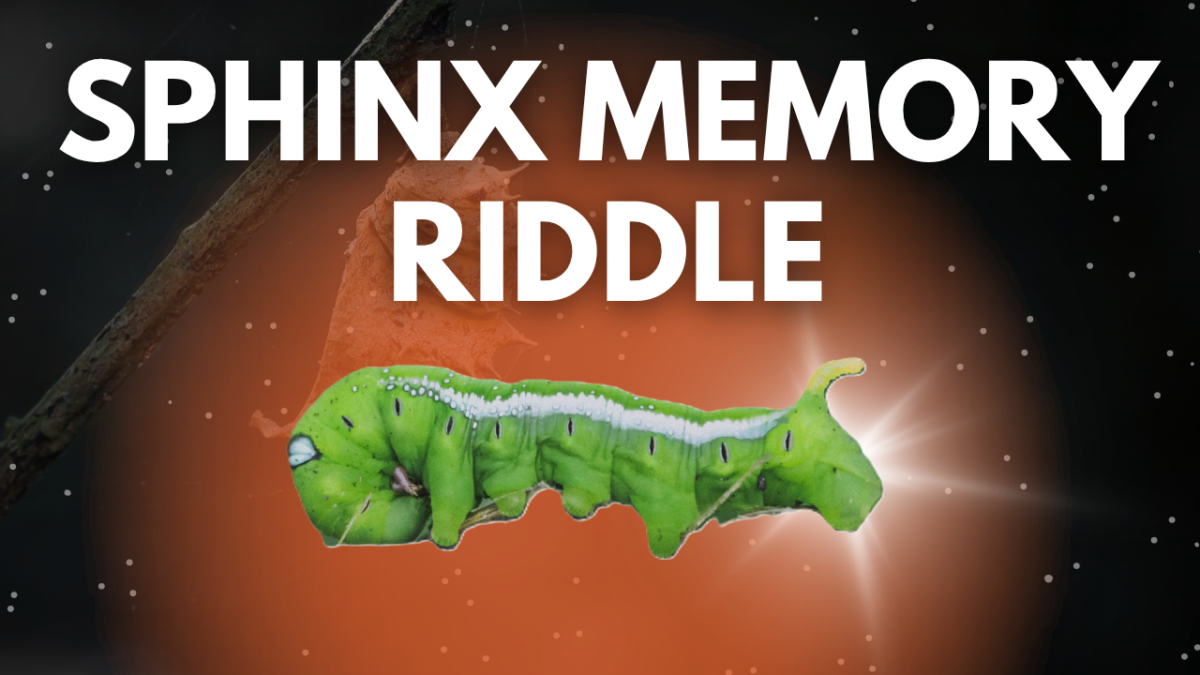
“And today we’re talking about a sphinx with a fascinating riddle. But more on that later.”
What happens to the very hungry caterpillar in the last pages of the book? “He stayed inside for more than two weeks,” it says… but did he really stay? Did he remain? Everyone learns about metamorphosis in school, but what actually happens inside a cocoon is so intense, it’s more like death and rebirth than transformation… still, some things persist through the biggest changes in Life, Death, and Taxonomy.
Description of the Carolina Sphinx
- About the size of your thumb as a caterpillar, but transforms into a chunky, aerodynamic moth that looks like it was designed by NASA.
- Thick, fuzzy body covered in soft gray and brown scales with subtle black-and-white striping.
- Long, narrow forewings with a camouflage pattern that resembles weathered tree bark.
- Bright orange hindwings hidden underneath until it takes flight.
- Large dark eyes and a ridiculously long straw-like tongue that unrolls like a party favor to sip nectar.
- Caterpillars are bright green with diagonal white stripes running down their sides.
- Sports a harmless curved “horn” sticking off its rear end, giving it the nickname “hornworm” despite having absolutely zero interest in jousting.
Measure Up
Welcome to the beloved Measure Up segment. The official listener’s favorite part of the show! The part of the show when we present the animal’s size and dimension in relatable terms through a quiz that’s fun for the whole family. It’s also the part of the show that’s introduced by you when you send in audio of yourself saying, singing, or chittering the words Measure Up into ldtaxonomy at gmail dot com.
Caterpillar Length
75–100 mm (3–4 inches)
Cultivated tobacco is an annually grown herbaceous plant that’s native to the Caribbean. It’s mostly used in nicotine products, but it can also be used as a natural insecticide and insect repellant. True or False– 18 caterpillars go into the height of a tobacco plant.
True. 3 to 6 feet (1 to 2 meters)
Moth wingspan
9.5-12 cm (4.7 inches)
The Great Sphinx of Giza is a limestone statue of a reclining sphinx, a mythical creature with the head of a human and the body of a lion. True or False– 180 sphinx moths go into height of the great sphinx of Giza.
False. The sphinx is 20 meters (66 feet) high.
Fast Facts about the Carolina Sphinx
- Primary Fact: Scientists trained caterpillars to avoid certain smells using mild electric shocks. After metamorphosis, the adult moths still remembered the lesson, proving that at least some memories survive the caterpillar-to-moth makeover. It’s basically the insect equivalent of remembering your kindergarten teacher after getting a completely new body.
- Range: Found throughout much of North and South America, especially across the southeastern United States, Mexico, and the Caribbean.
- Habitat: Lives anywhere its favorite plants grow—gardens, farms, forest edges, grasslands, and weedy fields.
- Diet: Caterpillars are voracious leaf-eaters, especially fond of tobacco, tomatoes, peppers, eggplants, and other nightshade plants. Adults switch to an all-liquid diet of flower nectar.
- Pollination: Adults hover like tiny hummingbirds while feeding, making them excellent nighttime pollinators for flowers with long nectar tubes.
- Mating: Females release airborne pheromones after dark, and males can detect them from impressive distances with their feather-like antennae.
- Behavior: Mostly active at dusk and night, flying with astonishing speed and precision despite looking like a fuzzy cigar with wings.
- Predators: Birds, bats, spiders, mantises, parasitic wasps, and tachinid flies all consider them part of a balanced breakfast.
- Life Cycle: They spend only a few weeks as adults, but most of their lives are devoted to eating, growing, pupating underground, and then emerging ready to fly like they totally didn’t spend weeks as a leaf vacuum.
Major Fact: The Sphinx Memory Riddle
If you were to cut open a chrysalis mid-metamorphasis, what would you find?
Not a half-baked butterfly, or a moth-caterpillar hybrid. You’d find slim, goo, genetic liquid.
Inside a cocoon, a caterpillar is fully unmade. It essentially melts from this inside by releasing a corrosive chemical called caspases. Caspases are used, even in humans, to destroy bad cells, like cancer cells. But caspases in a caterpillar in a cocoon destroy every cell down to its brain and nervous system.
Caterpillars walk around with imaginal discs–-organized clumps of undifferentiated cells they act like blueprints for the adult insect’s body. But the larva’s immune system fights them off. Once the caterpillar is turned to bug smoothie, the imaginal discs are unleashed, constructing a butterfly using the nutrients of the ooze.
By most metrics, a caterpillar dies and a moth is born from the imaginal discs left behind. They are essentially two different animals. Or are they?
A 2008 study investigated whether insects retain memories after undergoing complete metamorphosis. Why should they? The caterpillar’s whole brain was destroyed?
Here’s what they did:
- Researchers trained caterpillars to avoid the smell of ethyl acetate.
- They paired the odor with a mild electric shock, teaching the caterpillars that the smell predicted something unpleasant.
- The caterpillars were tested to confirm they had learned the association. (When they smelled chemicals, they fled.
- After they transformed into adult moths, the researchers tested whether the adults still avoided the same odor.
The result. They remembered! The adult moths continued to avoid the odor they had learned to dislike as caterpillars, showing that the memory survived metamorphosis.
Only when the caterpillars were trained in the last instars…
It makes sense why a moth would need to remember what it went through as a caterpillar. For instance, adult insects may prefer or avoid plants they encountered as caterpillars or larval experiences may shape where adults live or lay eggs.
The question is how. Researchers say that some neurons may survive and float around in the goo until they are recycled into the moth’s body. And epigenetics may play a role. Epigenetics is the study of changes in gene expression that occur without altering the DNA sequence.
Experiences the caterpillar have may alter gene expression, so when surviving neurons are being rebuilt into the moth brain, the altered genes rebuild the memory.
Ending
Eat your leafy greens, always always always pupate underground, and remember the lessons from your youth like the Carolina Sphinx here in LDT.