
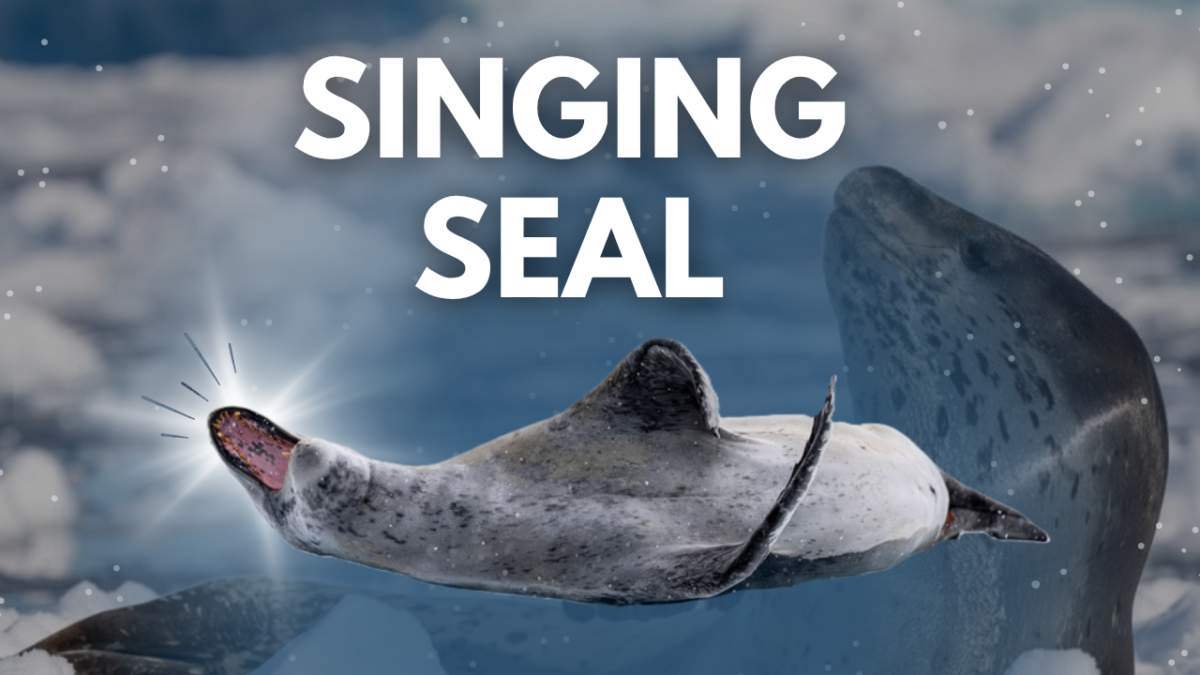
“…today we’re talking about a toothy torpedo. But more on that later.”
The leopard seal is a terrifying arctic predator. With a mouth full of teeth and a long jaw built for coming, it looks as much like a dinosaur as it does a sea mammal. Despite its efficiency as a fighter, it’s also something of a lover… singing sweet songs to its long lost mates to find them somewhere in the deep… But that’s the duality of Life, Death, and Taxonomy.
Description of the Leopard Seal
- Long, sleek body built like a torpedo with an unusually long neck for a seal.
- Silvery-gray back fading into a pale white belly that’s peppered with dark spots, giving it its “leopard” look.
- Covered in short, smooth, waterproof fur that looks almost polished when wet.
- Massive head with a wide dog-like jaw
- Possesses enormous canine teeth paired with finely combed molars that can strain tiny krill
- Huge black eyes adapted for hunting in dim Antarctic waters.
- Front flippers are surprisingly powerful, while the rear flippers provide excellent steering underwater.
Measure Up
This episode was suggested by Eva who writes…
“Hii!! Idk if you guys still take requests I’m only on episode 160 but if you do I’d be over the moon if you did Leopard Seals! (Fun fact Males sing to court females)
I really appreciate that you guys don’t demonize/ villainize animals, especially the ones that eat “cute” animals. It’s really refreshing to see.
Isolde says Measure up!” (she attached a picture of an aquarium with what I think is a beta fish)
Length
The overall length of adults is 2.4–3.5 m (7.9–11.5 ft)
Krill are a huge part of aquatic mammal diets… and they have a tendency to stick together in swarms, sometimes reaching densities of 10,000–30,000 animals per cubic metre… True or False– a leopard seal would have to eat 500 krill to eat its length in krill.
True. Antarctic krill (Euphausia superba) have a body length of 5–7 mm.
Weight
Weight is in the range 200 to 600 kilograms (440 to 1,320 lb)
Mark 48 Heavyweight Torpedoes are launched from submarines and carry larger warheads than lightweight variety torpedoes. The Advanced Capability variant of the Mark 48 was developed in 1985. True or False – One leopard seal goes into the weight of a Mark 48 ADCAP.
False. Mark 48 ADCAP is approximately 3,695 lbs (1,676 kg).
Fast Facts about the Leopard Seal
- Range: Found all around Antarctica and the surrounding Southern Ocean, though adventurous individuals occasionally wander as far north as Australia, New Zealand, South America, and South Africa.
- Habitat: Prefers pack ice and icy coastal waters where seals, penguins, and fish are all conveniently available on the same menu.
- Diet: Eats just about everything—krill, squid, fish, penguins, seabirds, seal pups, and occasionally other seals.
- Hunting: Famous for violently shaking penguins across the water’s surface to remove feathers before swallowing them.
- Social Behavior: Usually solitary, only gathering briefly during breeding season. They’re the introverts of Antarctica—except the introvert weighs over half a ton.
- Sounds: Their underwater calls include haunting trills, moans, whistles, and pulsing notes.
- Predators: Adults have almost nothing to fear except large killer whales. Leopard seal pups occasionally fall victim to other leopard seals.
- Lifespan: Typically lives 20–30 years in the wild.
- Oddball Fact: Despite their fearsome reputation, leopard seals have occasionally approached human divers out of curiosity and have even been observed bringing live penguins to them.
Major Fact: Sing Low
Leopard Seals sing sweet siren songs to their mates…
During the austral summer breeding season, male leopard seals produce loud, elaborate underwater vocalizations for hours each day.
Researchers in 2002 investigated whether adult male leopard seals have individually recognizable “songs” during the breeding season by analyzing underwater recordings from Prydz Bay, East Antarctica.
Recorded the vocalizations of multiple adult male leopard seals. They examined the acoustic properties of individual calls (such as pitch and duration) and the sequence in which different calls were arranged into longer vocalizing bouts.
They found…
Each male produced a distinctive pattern of calls. The order in which different vocalizations were arranged was unique enough that researchers could identify the individual seal 83% of the time based solely on its vocal sequence.
The two most common call types were the high double trill and low double trill, which were remarkably consistent when produced by the same individual. Not just random or accidental sounds.
Although the high double trill varied somewhat among different seals, the low double trill was so similar between individuals that it usually could not be used to identify a particular seal by itself.
As a result, the sequence of calls was a much stronger individual signature than the sound of any single call.
Also, calling behavior changes with age: young males produce a wide variety of calls, while mature males rely on a smaller set of highly stereotyped calls. In other words, they learn the songs over time…
These unique songs are part of why they are difficult to keep and breed in captivity.
What makes this interesting?
Most animals that advertise their identity through sound do so by producing calls with unique acoustic characteristics (like different voices). Leopard seals appear to rely more on how they arrange their calls than on subtle differences in the calls themselves. Like how everyone knows Creed songs…
Why do they have distinct calls?
Leopard seals are solitary animals that are often separated by large distances.
Underwater sound degrades as it travels, making fine acoustic details harder to detect.
A recognizable pattern or “song” is likely more resistant to this degradation than the precise acoustic structure of an individual note.
Will there be updated research?
Research that requires close encounters with leopard seals stalled because of what happened the very next year. In 2003, British Antarctic Survey biologist Kirsty Brown became the first recorded person killed by a leopard seal while snorkeling near Rothera Research Station in Antarctica.
A leopard seal dragged her underwater for about six minutes, reaching depths of up to 70 meters (230 feet), and she drowned despite being rescued by her colleagues. She also suffered numerous bite and scratch injuries, mainly to her head and neck.
Experts suggested the seal may have mistaken Brown for a fur seal or attacked defensively after being startled. A later leopard seal encounter, in 2012, shows the species in a more positive light…
National Geographic photographer Paul Nicklen got in the water with a large female who showed initial aggression but became curious when he didn’t try to get away. She ended up bringing him many living, injured, and dead penguins… and seemed sad when he wouldn’t eat them. Only Orcas have done this before… besides our house cats…
Ending
So keep an eye out for orcas, fill up on delicious penguin meat, and sing your sweetheart a creepy love dirge like the leopard seal here in LDT