
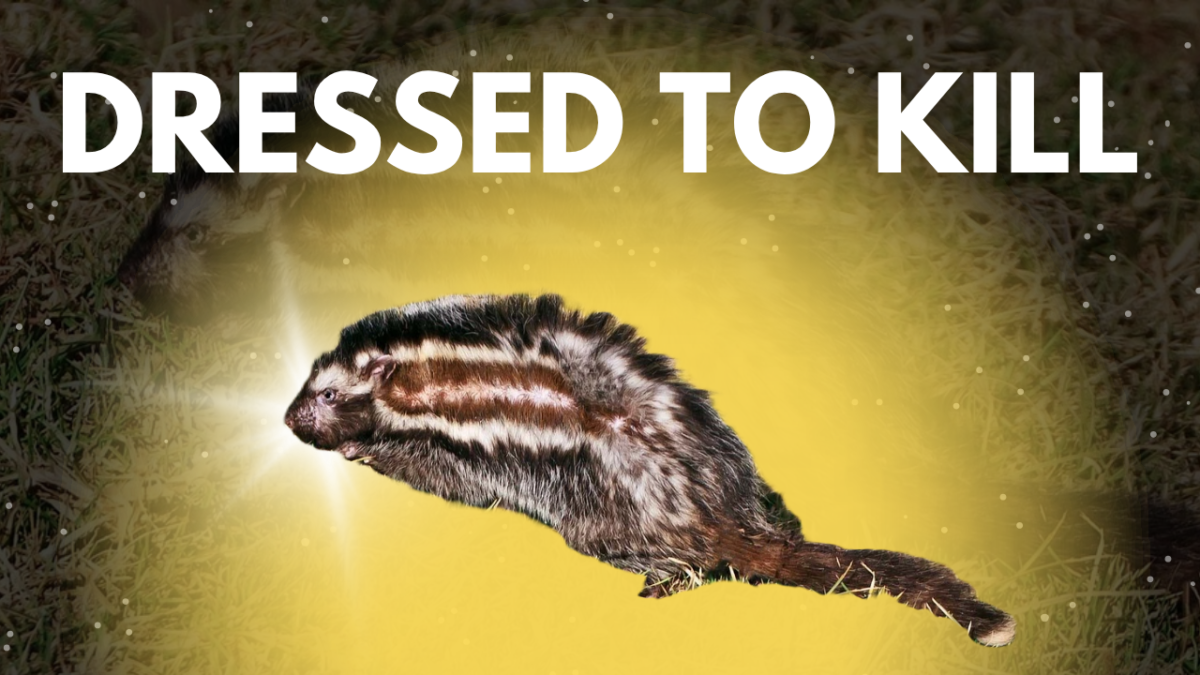
“…and today we’re talking about a fuzzy little creep. But more on that later.”
Out in the rocky woodland alleys of East Africa lurks a rodent that ain’t nothin but a heartache. The African crested rat waddles around in a spikey stripey overcoat like a tiny hedge skunk with a toxic secret. Unlike its murine kin, this mouse with a mohawk copies the human trait of using its chemical environment for defense. But if you’re not fast, strong, or hidden, you may as well be spicy like the African crested rat here in Life, Death, and Taxonomy.
Description of the African Crested Rat
They have a thick, multi-layered coat consisting of long silver and black-tipped guard hairs that cover a dense, soft, woolly grey-and-white undercoat. Its face and limbs are covered in short, black fur.
It has a prominent mane of longer, coarser black-and-white banded hairs that runs from the top of the head all the way down the back to just past the base of the tail.
It sort of looks like a little porcupine.
Measure Up
Welcome to the beloved Measure Up segment. The official listener’s favoritepart of the show! The part of the show when we present the animal’s size and dimension in relatable terms through a quiz that’s fun for the whole family. It’s also the part of the show that’s introduced by you when you send in audio of yourself saying, singing, or chittering the words Measure Up into ldtaxonomy at gmail dot com.
Charlotte’s Web (1973) – A Rat’s Paradise Scene (6/10) | Movieclips
Long
14.5–20.5 centimetres (5.7–8.1 in) long without tail.
The Bab al-Mandab strait connects the Red Sea with the Gulf of Aden. It’s a major global chokepoint for oil and trade, bordered by Yemen and Djibouti. True or False – 140,800 rats go into the width of the strait at its narrowest.
Bab al-Mandab strait is 16–18 miles (26–29 km)
Weight
590–920 g (21–32 oz)
A worker honey bee is a non-queen female bee that makes up the vast majority of a hive… True or false – an African crested rat would eat 6,133 honey bees to eat its weight in bees.
A worker bee is 150 mg.
Fast Facts about the African Crested Rat
Found from near sea level up to highland forests and woodlands in countries including Ethiopia, Somalia, Sudan, Kenya, Uganda, and Tanzania. They prefer rocky areas, hollow tree trunks, holes along ravines, and cliff-face rock crevices.
In the wild, it primarily eats leaves, fruit, and other plant material. In captivity, it also consumes meat, cereals, root vegetables, and insects.
It sits on its haunches and uses its forepaws to hold and bring food items to its mouth. Like a squirrel.
It is the only species in the superfamily Muroidea with a highly compartmentalized stomach, divided into five anatomically distinct sections that resemble the stomach of ruminant animals.
The rats often live in pairs and may form small family units with offspring. They appear to be monogamous — quite rare and “cuddly” behavior for such a well-protected rodent.
Major Fact: The devil wears nada (dressed to the spines)
- The African crested rat is one of the only known mammals that uses plant toxins as a chemical defense system.
- It chews the bark and roots of the poison arrow tree (Acokanthera schimperi), a plant historically used by humans to poison hunting arrows.
- Instead of swallowing the toxin, the rat carefully licks the poisonous mixture onto specialized hairs along its flanks.
- Those flank hairs are uniquely structured with tiny porous fibers that soak up and hold the poison.
- The toxin involved is a powerful cardiac glycoside called ouabain, which can interrupt sodium-potassium pumps in the heart cells and disrupt heart function in predators.
- When threatened, the rat raises its mane-like fur to expose these toxin-coated patches like a furry “break glass in case of predator” system.
- If a predator bites the rat in the wrong spot, it gets a mouthful of toxin potent enough to sicken—or potentially kill—it.
- Dogs that have attacked African crested rats have reportedly become violently ill, foaming at the mouth and retreating immediately. Lesson learned, hopefully.
- The rat advertises this danger with bold black-and-white warning coloration.
- This makes the African crested rat one of the very few mammals known to weaponize environmental toxins the same way poison dart frogs acquire toxins from their diet. And definitely the only rodent. But in this case, it’s intentional.
- Scientists believe this defensive strategy evolved because the rat is relatively slow-moving and awkward, meaning its best survival tactic is making predators instantly regret their decisions.
Ending
So hang out in the woodlands, munch on your favorite plants, and coat yourself in a toxic lugie like the african crested rat here in LDT.