
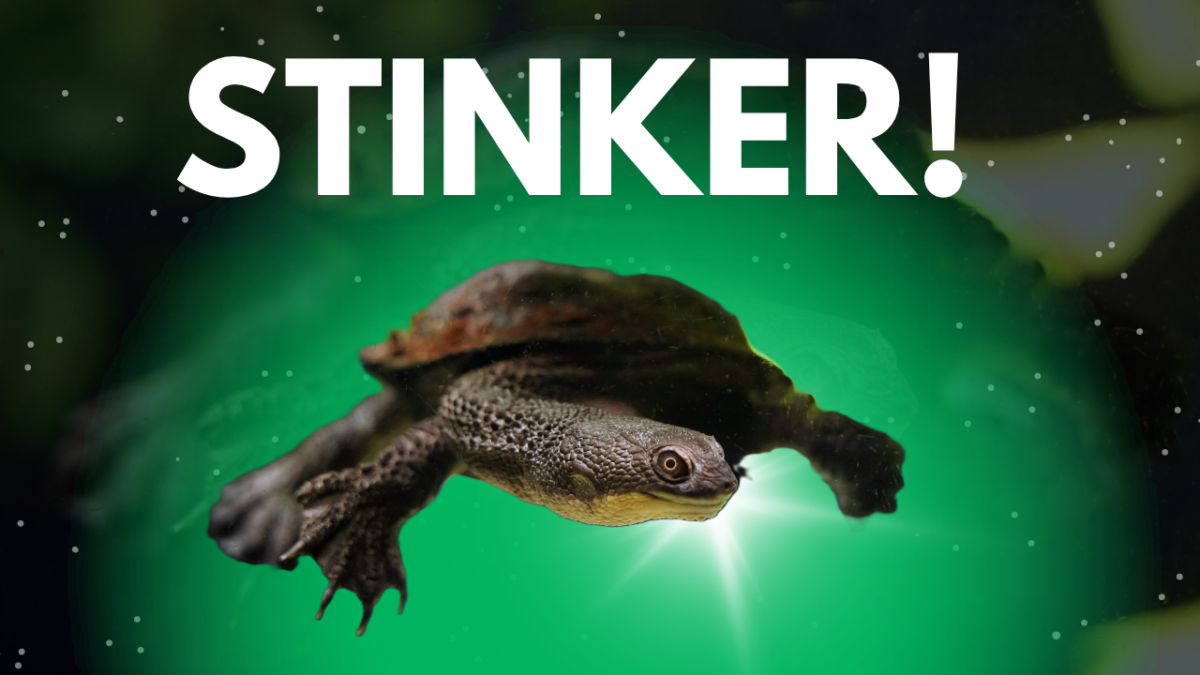
“…and today we’re talking about a stinky turt. But more on that later.”
A turtle is designed for defense… A tiny tank swimming around a river with an armored body that’s hardened against hungry fish and birds. But what if you share that river with creatures with huge jaws, capable of crushing even the tankiest turtle armor? Would you stick your neck out? You might… if you have some other tricks up your sleeve in Life, Death, and Taxonomy.
Description of the Eastern Long-Neck Turtle
- Looks like somebody stretched a normal turtle in Photoshop and forgot to hit undo
- Flat oval shell that ranges from dark brown to black
- Neck can get ridiculously long, sometimes nearly as long as the shell itself. Looks like a snake at times
- Belly shell is usually cream or yellowish with dark seam markings that look like coffee stains
- Skin is pebbly and leathery instead of smooth
- Head is narrow and pointy with little bead-like eyes
- Legs are short but strong with webbed feet and claws built for paddling through murky water
- Compared to a lot of turtles, it’s relatively lightweight and streamlined
Measure Up
Welcome to the beloved Measure Up segment. The official listener’s favorite part of the show! The part of the show when we present the animal’s size and dimension in relatable terms through a quiz that’s fun for the whole family. It’s also the part of the show that’s introduced by you when you send in audio of yourself saying, singing, or chittering the words Measure Up into ldtaxonomy at gmail dot com.
Over the Hedge (2006) – Turtle Pinball Scene (2/10) | Movieclips
Length
Females are 28.2 cm (11.1 in). Males are 24.9 cm (9.8 in).
The Styx River is found in the underworld in Greek Mythology and in the eastern portion of Central Queensland, Australia. True or False – 141,870 eastern long neck turtles go into the length of the Styx River.
Weight
450–800 grams (about 1–1.8 lbs)
Eastern Long neck turtles share an ecosystem with the common yabby…a crustacean that is bluish black to brown in nature but has been bred to be vibrant blue in the pet trade. True or False – an eastern long neck turtle would have to eat exactly 10 yabbies to eat its weight in yabbies.
The yabby is 20 to 80 grams.
Fast Facts about the Eastern Long-Neck Turtle
- Range: Found throughout eastern and southeastern Australia, especially in rivers, swamps, ponds, creeks, and farm dams. Basically if there’s muddy water and mosquitoes, this turtle already signed the lease.
- Diet: Carnivorous and opportunistic — eats insects, tadpoles, frogs, small fish, crustaceans, worms, and carrion.
- Hunting Behavior: Uses ambush tactics and snaps sideways with its neck to grab prey. The neck unfolds so fast it looks like a snake
- Defense Mechanism: Has specialized musk glands that release a foul-smelling liquid when threatened.
- Mating: Breeding usually happens in warmer months, and females can lay multiple clutches of eggs each season.
- Habitat Trick: Can travel surprisingly far over land between water sources, especially after rain.
- Lifespan: Often lives 20–30 years in the wild, and longer in captivity if predators and trying to cross busy highways don’t intervene.
- Social Behavior: Mostly solitary.
- Sounds: Generally quiet, but hatchlings and stressed turtles can make little hisses or squeaks.
- Predators: Eggs and juveniles get eaten by birds, foxes, monitor lizards, and large fish. Adults mainly rely on their shell, camouflage, and another tool they have hidden up their shell.
- Weird Bonus Fact: Unlike most turtles that retract their neck straight back, this species folds its neck sideways under the shell like a pool noodle.
Major Fact: A Little Stinker
The Eastern Long Neck Turtle releases a pungent yellow fluid from a pair of musk glands called the Rathke’s gland. They’re located in the armpits and groin regions–each gland can store up to 2.5 ml of yellowish fluid. When threatened, handled, or disturbed, it releases a pungent yellow fluid that can be sprayed or ejected a short distance — reportedly up to more than 3 feet (about 1 meter) in some accounts.
In 1979, researchers identified four ω-phenylalkanoic chemicals that really stink when mixed together…
- Phenylacetic acid
- 3-Phenylpropionic acid (also called hydrocinnamic acid)
- 5-Phenylpentanoic acid
- 7-Phenylheptanoic acid
At low concentrations, Omega phenylalkanoic acids are a sweet smelling honey-like scent that is sometimes used in perfumes. But it creates a pungent, urine-like, musty smell when concentrated.
Similar acids are found in human sweat and urine.
Why Does a Foul Smell Cause Animals to Pass Up a Meal?
Of course, something that stinks doesn’t sound appetizing, but it’s also true that humans learn to eat stinky things (cheese, durian, brussel sprouts) when we learn they are safe to eat…
Why don’t animals push through to get those all-important calories?
Many species have hardwired responses–it’s not a choice. For example, most animals find the smell of rotting flesh (cadaverine and putrescine) repulsive due to specialized olfactory receptors that trigger avoidance or disgust, signaling bacterial decomposition and potential disease.
Predators quickly associate a bad smell with bad post-meal experiences through conditioned taste or odor aversion. A single bad experience can lead to long-term avoidance of that smell or similar prey. This is also the reason you may have an aversion to food that gives you food poisoning for a long time.
Foul chemicals can irritate mucous membranes, cause nausea, or activate brain pathways linked to the vomiting center… making continued consumption highly unpleasant.
How Effective is the Defense?
A 1998 study found that musk-tainted food was avoided by some predators, including eels and freshwater crocodiles, suggesting it can work against certain species. Crocodiles are primordial eating machines whose food sometimes rots in their stomach and even they won’t touch these turts…
The study also noted possible aposematic (warning) behavior in hatchlings: some flipped onto their backs or oriented their bright orange-and-black plastron toward approaching eels while floating, suggesting a possible combination of warning coloration and noxious taste/smell.
Ending
So putz around in a pond, weaponize your BO, and spray and pray for your enemies like the eastern long-necked snake here in LDT.