
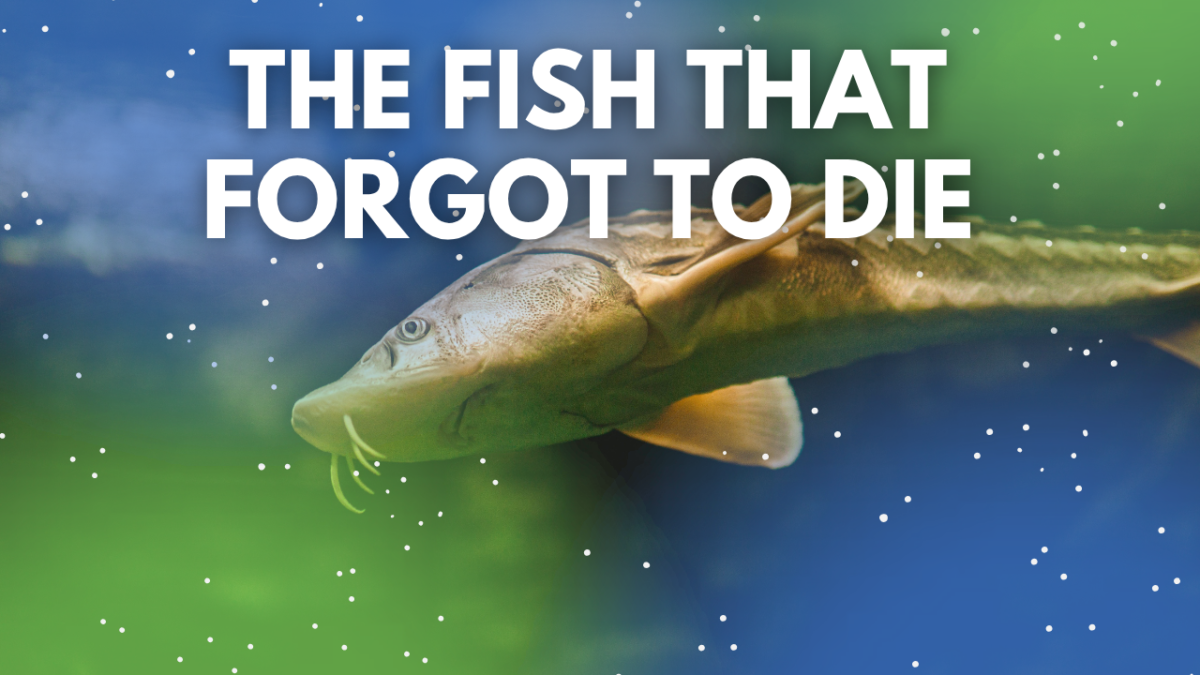
“…and today we’re talking about an old lake cigar. But more on that later.”
Deep beneath the murky waters of North America lives a massive fish with an armored body, a shovel-shaped snout, and a birth year that could easily start with an 18. This long-lived species has survived for eons, enduring dramatic changes to its environment while driving through life in the slow lane. But sometimes, rather than burning the candle at both ends, it’s best to live a long, chill life like the lake sturgeon here in Life, Death, and Taxonomy.
Thank you to Daniel White for the use of his song “Make Pangea Unified Again.” To hear more of Daniel’s music please visit Youtube dot com slash @DanielWhiteArtist.
Description of the Lake Sturgeon
- They have armor more than they have scales… Five rows of bony plates (called scutes) over coarse, leathery skin. These scutes smooth out with age.
- They have a shark-like heterocercal tail, which means the upper lobe is longer than lower.
- They have a pointed snout with four barbels (whisker looking things).
- They have a greyish back and a tan to white bellies.
Measure Up
Welcome to the beloved Measure Up segment. The official listener’s favorite part of the show! The part of the show when we present the animal’s size and dimension in relatable terms through a quiz that’s fun for the whole family. It’s also the part of the show that’s introduced by you when you send in audio of yourself saying, singing, or chittering the words Measure Up into ldtaxonomy at gmail dot com.
Lake Sturgeon is North America’s largest Great Lakes fish… (Largest in North America is the white sturgeon.) They commonly reach lengths of 6 to 7 feet and over 200 lbs. But verified giants reach 9 ft (274 cm) and max out weight around 125 kg (~276 lbs). Females run much bigger than males.
Length
9 feet
Regulation ping pong is governed by the International Table Tennis Federation (ITTF) and requires specific equipment dimensions and playing rules. True or False – they are 5 feet wide (60 inches), and 2.5 feet tall (30 inches), and exactly one sturgeon long.
True.
Weight
200 lbs
Cougars (Puma concolor), also known as pumas, mountain lions, or panthers, are large felines native to the Americas and represent the fourth largest cat species in the world. True or False – Large sturgeon are the same weight as a full grown male cougar.
True.
Fast Facts about the Lake Sturgeon
- They can be found in Lake St. Lawrence, the Great Lakes, Hudson Bay, and Mississippi River basins.
- Females spawn only every 3 to 5 years. A big female can release up to ~700,000 eggs in a season. Fewer than 1 in 1,000 eggs survive to hatch.
- They were considered nuisance fish in the 1860s. Commercial fishermen hated them because they tore nets. Sturgeon were stacked like cordwood on beaches and burned, fed to pigs, dug in as fertilizer, and used to fuel steamboat boilers.
- In 1865 German immigrants came hunting a substitute for fished-out Russian caviar; Lake Erie became the hub. The U.S. fishery peaked in 1885 at 8.6 million pounds — 5.2 million from Lake Erie alone, roughly 52,000 fish in a single year.
- They travel far Winnebago-tagged fish turned up 16 years later in Michigan’s Saginaw Bay, which is 850 miles through 14 dams, 17 locks, Lake Michigan, the Straits of Mackinac, and Lake Huron.
Major Fact: The Fish That Forgot to Die
Lake sturgeon can live for around 150 years, making them some of the longest-lived freshwater fish in North America. And newer research suggests we may have been selling these aquatic antiques short: a 2026 study estimated that some large females could be several centuries old, depending on the population and growth assumptions. That’s right: your fish might have been swimming around before the United States had its current number of states.
Their longevity is closely tied to their slow growth and delayed maturity. Rather than rushing through life, lake sturgeon take their sweet time growing up, with females often waiting until their twenties or later before reproducing.
Female lake sturgeon can spawn only once every several years. This means they don’t produce a fresh generation annually, making every successful spawning season particularly valuable to the population.
Their slow reproductive schedule creates a serious conservation challenge. When too many adults are harvested, there aren’t enough mature fish left to replace them quickly. A population can take decades to recover because the next generation needs years just to reach reproductive age.
Scientists estimate a sturgeon’s age by examining growth patterns in hard structures, such as fin rays or other bony tissues. However, growth becomes extremely slow in older fish, making age estimates tricky. It’s like trying to determine someone’s age from a photograph where the subject hasn’t visibly changed since the 1800s.
Lake sturgeon possess a skeleton made largely of cartilage rather than the fully ossified skeleton found in many other bony fishes. They also have five rows of protective bony scutes along their bodies, giving them an armored, prehistoric appearance.
Their bottom-feeding lifestyle helps them find food without needing to chase prey through the water column. Four sensitive barbels near the mouth help locate food along the river or lake bed, where they vacuum up insect larvae, mollusks, crayfish, and other small aquatic animals.
Their long lives give surviving adults many opportunities to reproduce over time. This can help populations persist through occasional poor spawning years, although it doesn’t protect them from sustained overfishing, pollution, or habitat destruction.
Dams pose a particularly nasty problem because they can prevent sturgeon from reaching their traditional spawning grounds. Lake sturgeon often migrate into rivers to reproduce, so blocking those routes can cut fish off from suitable breeding habitat and reduce successful recruitment.
Conservation efforts include fish stocking, habitat restoration, dam removal, and fish passages that restore access to spawning areas. Because lake sturgeon take so long to mature, protecting existing adults is especially important. Saving one large female today could mean preserving decades of future reproductive potential.
Ending
So be cartilaginous, tickle the sand with your barbels, and live to 150 like the lake sturgeon here in LDT.