
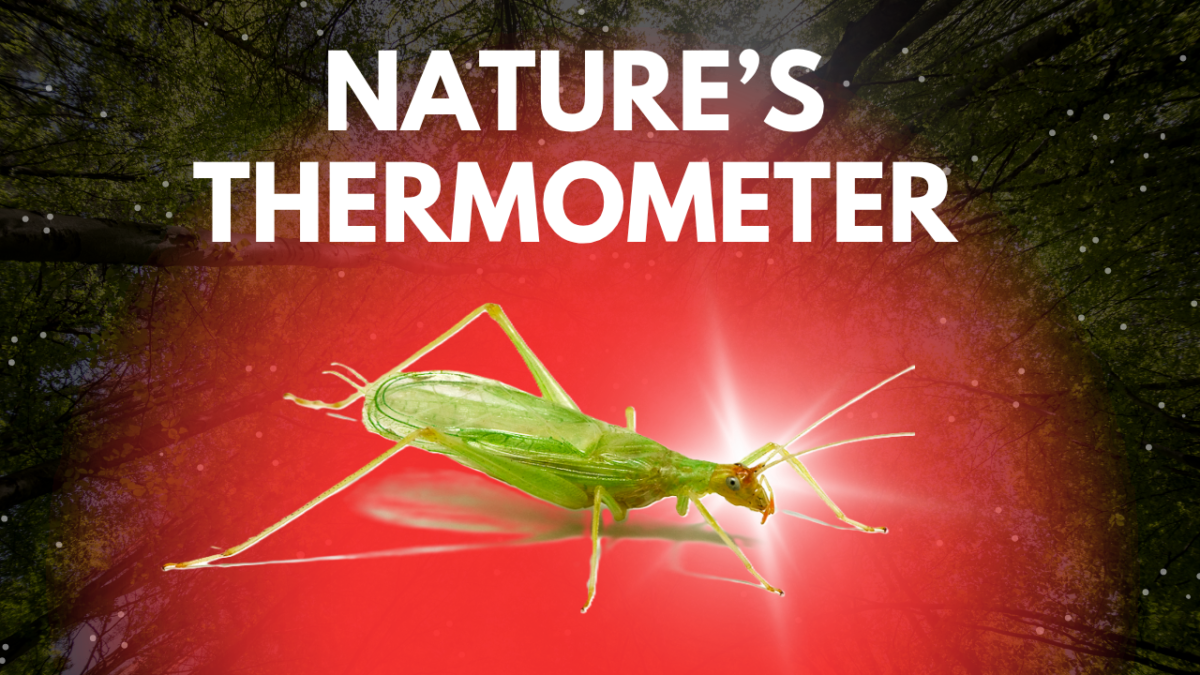
“…and today we’re talking about a bug that is a scientific instrument… but more on that later.”
In the sticky stillness of a summer night, a tiny troubadour tunes up in the trees. This pale, unassuming performer doesn’t just chirp—it engineers, improvises, and even has custom acoustics. This backyard busker sings its love song using some unorthodox methods. But if you’ve ever lived in a big family, you know you have to find a way to make yourself heard like the Thermometer Cricket here in Life, Death, and Taxonomy.
Description of the Thermometer Cricket
Pale, whitish, or light green — hence the “snowy” name (not because they appear in snow, but due to their light coloration).
They have slender bodies with long antennae, typical of tree crickets (family Oecanthidae).
Measure Up
Welcome to the beloved Measure Up segment. The official listener’s favorite part of the show! The part of the show when we present the animal’s size and dimension in relatable terms through a quiz that’s fun for the whole family. It’s also the part of the show that’s introduced by you when you send in audio of yourself saying, singing, or chittering the words Measure Up into ldtaxonomy at gmail dot com.
Jiminy Cricket – I’m No Fool – 1955 – I’m No Fool With Fire
Adult Length
15–18 mm (0.6–0.7 in)
Fenway Park, home of the Boston Red Sox, has the furthest distance from home plate to the outfield wall in Major League Baseball. Despite this, it’s not among the least home-run friendly parks in the MLB. PNC Park (Pittsburgh Pirates) is the least home-run-friendly allowing just 116 homers in 2025. (Do you know what the most hitter friendly park is?) True or False – Fenway’s home plate is 7,112 crickets away from the back wall in right-center.
Fenway is 420 feet deep.
Egg Size
3 mm (0.1 inches)
After chickens, duck eggs are the most commonly consumed type of egg in the world and in the United States. True or False – 23 cricket eggs go into the length of a duck egg.
A duck egg can be as long as 70 mm.
Fast Facts about the Thermometer Cricket
They live in trees, shrubs, and tall vegetation across much of the United States and parts of Canada. They are most active from mid-summer through fall (July–October).
Primarily leaves and plant matter, but they also eat small insects like aphids.
Both nymphs and adults of the Snowy Tree Cricket (Oecanthus fultoni) primarily feed on leaves, causing very little damage to plants. However, they can become minor pests in orchards.
Females drill a hole into the cambium of twigs to lay their eggs, then seal the hole with excrement or chewed plant tissue. Adults also chew holes into ripe fruits such as apples, plums, peaches, and cherries, which often causes the fruit to rot.
Despite this, the species rarely causes significant damage in commercial orchards that are regularly sprayed with insecticides.
Male snowy tree crickets produce a high-pitched, rhythmic chirping sound by rubbing their wings together (a process called stridulation). Because they are ectothermic (cold-blooded), their body temperature matches the surrounding air, which directly affects how quickly their wing muscles contract. Warmer temperatures mean faster chirping; cooler temperatures mean slower chirping.
This reliable relationship earned them the nickname “thermometer cricket.” A simple field formula often used is:
- Count the number of chirps in 15 seconds (or sometimes 13–14 seconds).
- Add 40.
- The result is a close estimate of the temperature in degrees Fahrenheit.
Example: 35 chirps in 15 seconds + 40 ≈ 75°F.
Major Fact: Sylvan Singer
- The Thermometer Cricket doesn’t just chirp into the void—it modifies its environment to boost its signal.
- Males will chew a precise hole in the center of a leaf, creating a natural sound amplifier.
- This leaf acts like a baffle, increasing the volume and clarity of the cricket’s call.
- Louder calls mean better chances of attracting a mate—because apparently volume does equal confidence.
- The leaf baffle helps project sound farther without requiring extra energy from the cricket.
- This is especially useful in dense vegetation where sound can easily get muffled.
- The cricket positions itself strategically in the hole, turning the leaf into a tiny acoustic stage.
- By amplifying its chirps, the cricket can outcompete quieter rivals nearby.
- The behavior shows a surprising level of environmental manipulation for such a small insect.
- It’s essentially bioengineering on a budget: no tools, no blueprints, just vibes and leaf holes.
Ending
So hug a tree, chirp out the temperature, and create a kazoo with the local flora like the thermometer cricket