
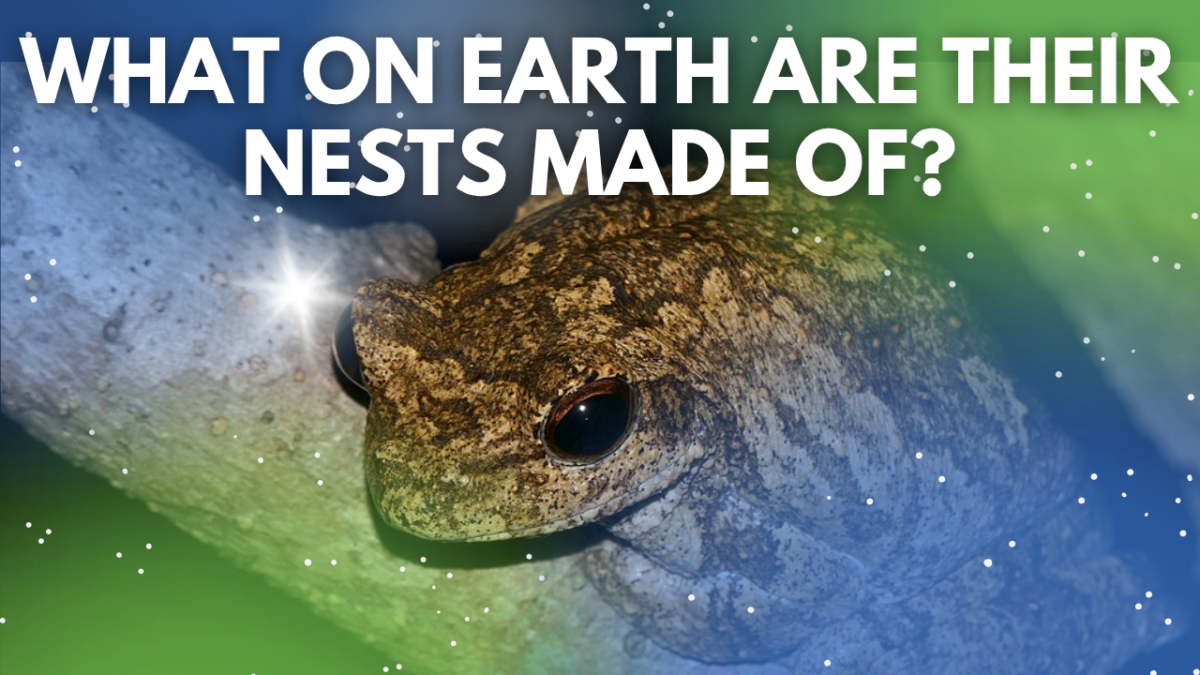
“…and today we’re talking about a modern insulator… but more on that inso-later.”
Description of the Foam Nest Tree Frog
- They have a compact and somewhat flattened body, with slightly bumpy, dry-looking skin.
- They can range from chalky white to brown.
- The brown coloration often forms a geometric, bark-like pattern, helping the frog blend into tree trunks and branches.
- They have large eyes suited to its nocturnal lifestyle.
- It has rounded adhesive discs on its toes that help it climb.
Measure Up
Welcome to the beloved Measure Up segment. The official listener’s favorite part of the show! The part of the show when we present the animal’s size and dimension in relatable terms through a quiz that’s fun for the whole family. It’s also the part of the show that’s introduced by you when you send in audio of yourself saying, singing, or chittering the words Measure Up into ldtaxonomy at gmail dot com.
Male Length
43–75 mm
A soda straw is a hollow, cylindrical mineral formation found in caves, also called a tubular stalactite. It forms when mineral-rich water slowly drips through cracks in a cave ceiling, depositing minerals around the edges of the water and creating a thin tube. They typically grow less than a few millimeters per year, sometimes averaging only 0.1 mm per year. The longest of these straws was found in Wonder Cave in Gunung Mulu National Park, Malaysia. True or False – The longest soda straw is 122 male frogs long.
True. The longest soda straw is around 9.13 meters (30 feet).
Female Length
60–90 mm
South Africa has a semi-arid climate, with rainfall distribution varying heavily by region and season. True or False – South Africa receives about 10.5 female frogs of rainfall annually.
False. 464 mm (about 18 inches) lower than the global average of 860–950 mm.
Fast Facts about the Foam Nest Tree Frog
The grey foam-nest tree frog enjoys environments of all kinds… including savannahs, shrublands, forests, pastures, and urban areas. They need humidity and avoid extremely arid conditions, but they can survive dry seasons in habitats like dry forests and savannahs by sheltering under loose bark.
It can lose up to 60% of its body weight during prolonged drought and conserves water by producing mostly uric acid, which can be excreted with little water loss. Its highly water-resistant skin, water-conserving physiology, and ability to change color from chalky white to dark brown help it survive months away from water. During dry periods, it shelters with its resistant skin exposed and seals itself with waterproof mucus.
Heavy rainfall triggers breeding, as increased humidity improves egg and juvenile survival. Habitat destruction and human disturbance can significantly interfere with breeding.
The grey foam-nest tree frog breeds during the rainy season, typically from October to February. Mating taking place at night on tree branches above water. Females are polyandrous… often mating with 10 or more males, which can improve fertilization and offspring survival.
Grey foam-nest tree frogs are insectivores, feeding primarily on insects and other small arthropods. Their diet includes things such as beetles, moths, flies, termites, and other small invertebrates.
They are primarily ambush predators, catching prey with their sticky, rapidly extending tongues. Juveniles and tadpoles have different diets, with tadpoles feeding on algae, plant material, and organic matter in the water.