
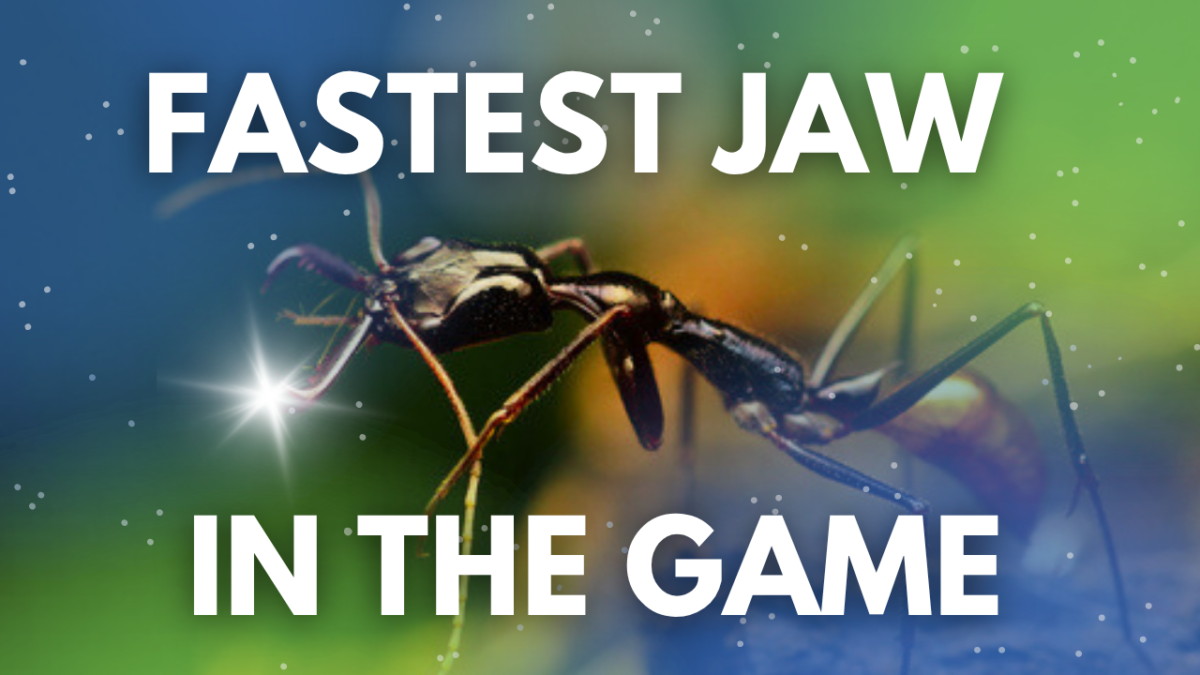
“And today we’re talking about the fastest animal alive. But more on that later.”
Speed is a key stat in the animal kingdom… the peregrine falcon, the cheetah, and the sailfish all have their speed superlatives… but one bug doesn’t need to be the fastest flyer, sprinter, or swimmer… he just needs to be fastest on the draw… To spring a trap faster than your enemies can think… that’s real speed in Life, Death, and Taxonomy.
Description of the Trap Jaw Ant
- Looks like a fairly large ant that somebody accidentally equipped with a pair of miniature bear traps for a mouth.
- Dark brown to nearly black body with a smooth, shiny abdomen and a somewhat reddish-brown cast in some individuals.
- Long, slender legs give it a lankier look than your standard sidewalk ant.
- Large head with elongated mandibles that can swing dramatically open, giving the ant a permanently prepared-for-nonsense expression.
- The mandibles are broad and stout rather than needle-sharp, with teeth along their inner edges.
- Has a distinctive dome-shaped section of the body called the petiole, topped with a slender upward-pointing spine.
- Like other ants, the body is divided into head, thorax, and abdomen, with six legs and elbowed antennae. Basically: tiny insect, maximum hardware.
Measure Up
Welcome to the beloved Measure Up segment. The official listener’s favorite part of the show! The part of the show when we present the animal’s size and dimension in relatable terms through a quiz that’s fun for the whole family. It’s also the part of the show that’s introduced by you when you send in audio of yourself saying, singing, or chittering the words Measure Up into ldtaxonomy at gmail dot com.
Honey I Shrunk The Kids – Riding Ants
Workers: roughly 8–10 mm (0.31–0.39 in) long
Andes chocolate mints are small, rectangular candies made of three layers: a mint-green crème de menthe center between two chocolate-flavored layers. Even though they are named for the Andes Mountain and you get them at an Italian Restaurant. They originate from the Tootsie Roll company in Delavan, Wisconsin. True or False – five workers go into an Andes mint.
False. An andes mint is 1.5 inches (3.8 cm) long
Queens: generally larger, around 10–12 mm (0.39–0.47 in)
The Andes Mountain range is the longest continental range in the world. True or False – 537 million ants go into the length of the Andes mountains.
False. The range is 8,900 kilometres (5,500 mi) long. Over 700 billion.
Fast Facts about the Trap Jaw Ant
- Range: Found from Costa Rica through tropical South America, as well as the Galápagos and much of the West Indies. Basically, if you have tropical forests and leaf litter in the Western Hemisphere, keep an eye out for jaws.
- Habitat: Often lives and hunts in leaf litter, rotten wood, under objects on the ground, or in cavities and epiphytes up in the forest canopy. It is surprisingly tolerant of seasonally dry habitats compared with many of its relatives.
- Diet: A predator and occasional scavenger that eats a variety of small invertebrates, especially ants and termites. Soft-bodied prey such as termites and woodlice are particularly popular on the menu.
- Hunting: Usually forages alone rather than together. Workers patrol the leaf litter, poke around in cracks and crevices, and can even return to spots where they previously found food.
- Social Life: Colonies are generally modest in size, with roughly a few hundred workers reported in studied populations. Colonies can be monogynous, meaning one queen runs the whole operation.
- Mating: Reproductive males and winged queens take part in nuptial flights, with records of reproductive activity occurring throughout much of the year depending on location.
- Predator Problems: When threatened they can sting.
- Strength: The jaw strike can generate forces exceeding 300 times the ant’s own body weight. For something weighing only around a dozen milligrams, that is an absolutely ridiculous amount of mechanical enthusiasm.
- Name Drop: The species name bauri honors George Baur, the naturalist whose Galápagos collections included the material used in describing the species.
Major Fact: The Fastest Animal
Trap Jaw Ants are technically the fastest moving animal.
Trap-jaw ants possess powerful, spring-loaded mandibles that snap shut at extremely high speeds and accelerations. They use these for capturing or stunning prey and fighting other ants.
The jaws are extraordinarily fast. In Odontomachus bauri, jaw strikes can reach about 38 m/s (85 mph) and accelerations around 100,000 g, with the entire strike occurring in roughly 0.13 milliseconds.
How Does it Work?
- Trap-jaw ants have spring-loaded mandibles. Instead of relying directly on muscle contraction to close their jaws, they first use their muscles to load energy into a spring-like mechanism. A latch holds that energy until the ant releases it, producing an extremely rapid strike.
- Trigger hairs act like sensors. Hairs near the mandibles connect to neurons that control the latch. When a trigger hair contacts something, it can cause the latch to release almost immediately.
The jaws can actually launch the ant into the air. When the mandibles slam against a surface, the force can exceed the ant’s body weight. The resulting reaction force can propel the ant more than 20 body lengths into the air.
This helps trap jaws escape predators that are normally inescapable… including the ant lion.
The jumping can also deter predators. Groups of ants can simultaneously launch themselves into the air, creating a startling “popcorn” effect. They may land on the predator and sting it, combining jumping + stinging into an effective defense.
Ending
So enjoy some moist leaf litter, snap your mandibles shut at a fifth of the speed of sound, and soar through the skies with your friends like the trap jaw ant here in LDT.