

“…and today we’re talking about a pileated pile driver. But more on that later.”
Somewhere deep in the forest, a feathered jackhammer slaves away to fill all the trees with holes. The pileated woodpecker attacks hardwood with its whole face and somehow strolls away from repeated headfirst collisions with nary a scratch, let alone constant concussions. It’s a biological engineering marvel with a mohawk. But sometimes you have to have special headgear to be a woodland wrecking ball like the Pileated Woodpecker here in Life, Death, and Taxonomy.
Description of the Pileated Woodpecker
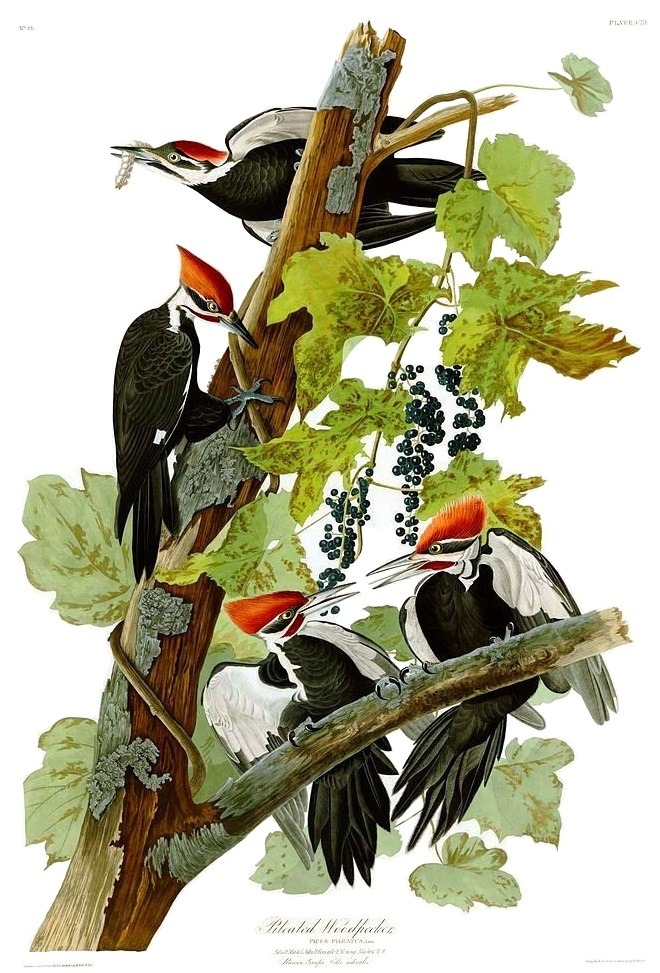
Mostly black body with bold white stripes on the face and neck.
Prominent, flaming-red crest. Males have a red “mustache” (malar) stripe; females have a black one. In flight, large white patches flash on the underwings, and it flies with deep, rowing wingbeats.
Measure Up
Welcome to the beloved Measure Up segment. The official listener’s favorite part of the show! The part of the show when we present the animal’s size and dimension in relatable terms through a quiz that’s fun for the whole family. It’s also the part of the show that’s introduced by you when you send in audio of yourself saying, singing, or chittering the words Measure Up into ldtaxonomy at gmail dot com.
Woody’s Melting! | Woody Woodpecker | 1 Hour Compilation
Length
Adults are 40 to 49 cm (16 to 19 in) long, with a wingspan 66 to 75 cm (26 to 30 in).
Carl Linnaeus was a Dutch biologist, a contemporary of Benjamin Franklin, that invented binomial nomenclature. There is a statue of Carl Linnaeus on the University of Chicago’s Midway Plaisance, on a large granite monument. True or False – 6 woodpecker wingspans go into the height of the statute.
The statue is 15 feet tall.
Weight
8.8–12.3 oz (250–350 g)
Mr. President and Lotus are the names of Washington D.C.’s most famous bald eagle pair…nesting in the U.S. National Arboretum. Lotus laid a new egg in March 2026, with hatching anticipated in April… but I can’t find any info on if it all went to plan. Bald eagles prey upon adult pileated woodpeckers. True or False – An adult male eagle would need to eat 19 whole woodpeckers to eat his weight in woodpeckers.
Males are 11 pounds. Female bald eagles are larger than males and can weigh up to 15 pounds.
Fast Facts
The Pileated Woodpecker breeds in forested areas across Canada, the eastern United States, and parts of the Pacific Coast.
It prefers mature forests with large, mature hardwood trees in mesic (moderately moist) habitats. They prefer large tracts of forest but may use smaller woodlots as long as they contain tall trees.
Woodpeckers are primarily insectivorous… They especially like carpenter ants and wood-boring beetle larvae, but they also might eat fruits, nuts, and berries (including from poison ivy).
Pileated Woodpeckers forage primarily by chiseling out large, roughly rectangular holes in trees to access insects…using their long tongues to lap up ants from deep crevices.
They serve as clean up crews for dead trees… Pileated Woodpeckers usually excavate their own large nest cavities in decaying trees. These holes are so big that they can occasionally cause a small tree to snap in half, which accelerates the breakdown of dead and dying trees to make room for new growth.
Pileated Woodpeckers form strong pair bonds and stay together on their territory year-round. They are non-migratory and actively defend their territory in all seasons, though they are more tolerant of “floaters” (non-territorial birds) during winter.
What Predators Eat Pileated Woodpeckers?
Nests are vulnerable to several predators, including American and Pacific martens, weasels, squirrels, rat snakes, and gray foxes. Free-flying adult Pileated Woodpeckers face fewer threats, but can be preyed upon by various raptors, including Cooper’s Hawks, Northern Goshawks, Red-shouldered Hawks, Red-tailed Hawks, Great Horned Owls, Barred Owls, Bald Eagles, and Golden Eagles.
Major Fact: Torque in the Load
- The pileated woodpecker has a heavily reinforced skull specifically adapted to absorb repeated high-speed impacts from pecking (15 mph).
- Powerful neck muscles act like biological suspension systems, helping control and soften each strike.
- The woodpecker’s skull is not designed to absorb impacts, it’s designed to reduce rotational force torque
- In birds, the lower jaw is not directly articulated with the braincase as in mammals. Instead, jaw suspension depends on a separate bone known as the quadrate.
- The quadrate is reduced in the woodpecker, which elevates the lower jaw, while the lowered profile of the upper beak base decreases rotational stresses acting on the beak itself. In combination, these modifications promote axial alignment between the beak and the skull, improving mechanical stability during impact.
- Excessive torque can destabilize even very strong structures, the challenge becomes even greater in birds, where the cranial joints are designed for mobility rather than rigidity.
- Provides mobility but also introduces potential mechanical instability under high-impact conditions.
- Like a boxer bracing for a blow and preventing the head from twisting, woodpeckers possess a cranial configuration that suppresses destabilizing rotational tendencies.
- A specialized hyoid apparatus — a bizarre tongue-support bone and muscle structure that wraps around the skull — helps distribute force away from the brain.
- The beak itself absorbs part of the impact energy, functioning almost like a built-in crumple zone on a tiny feathery car.
- Pileated woodpeckers can strike wood up to 20 times per second without suffering concussions.
- This adaptation allows them to excavate deep rectangular holes into trees while hunting carpenter ants, beetle larvae, and other insects.
- Without these adaptations, repeatedly slamming face-first into oak trees would eventually kill them.
Ending
So drill some holes, listen for the sound of nature’s heavy machinery, and appreciate the miracle of bone headed hard hats like the pileated woodpecker here in LDT.