
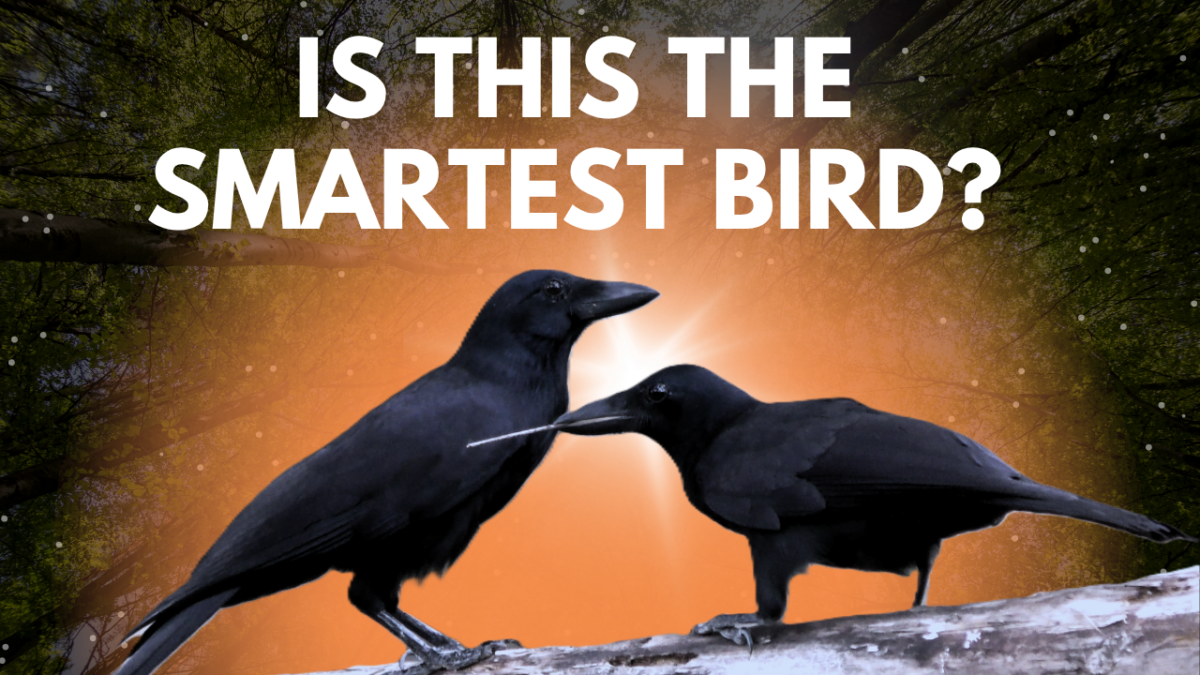
“…and now we’re talking to high quality bird brains. But more on that later.”
What does the crow know?
Accounts, it does not grow.
Seeds, it does not sow.
But knowing it will show.
When life asks the crow…
To think to earn its dough.
The new caledonian crow may be among the smartest birds in the animal kingdom… even showing talents we once thought were an exclusive part of the human Life, Death, and Taxonomy.
Description of the New Caledonian Crow
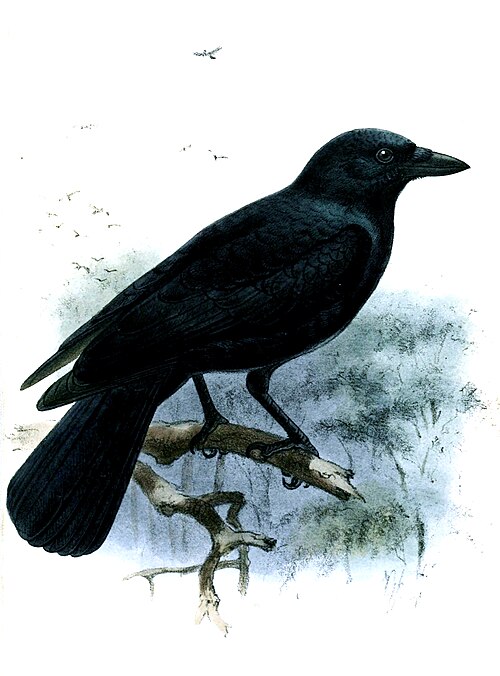
- A sleek, all-black bird that looks like it just stepped out of a noir film and definitely knows something you don’t
- Feathers have a subtle glossy sheen, like it conditioned them with midnight
- Medium-sized for a crow, but carries itself like it’s got a PhD
- Thick, slightly curved beak that looks purpose-built for “figuring stuff out”
- Dark eyes that give off strong “I’m judging your life choices” vibes
- Legs and feet are sturdy, good for perching, hopping, and generally acting like they own the place
- Tail is moderately long and squared off, giving it a balanced, streamlined silhouette
Measure Up
Welcome to the beloved Measure Up segment. The official listener’s favorite part of the show! The part of the show when we present the animal’s size and dimension in relatable terms through a quiz that’s fun for the whole family. It’s also the part of the show that’s introduced by you when you send in audio of yourself saying, singing, or chittering the words Measure Up into ldtaxonomy at gmail dot com.
Dumbo When I See an Elephant Fly & Dumbo Flies HD
Notes:
- The lead is James “Dandy” Crow– shortened to just Dandy Crow in modern credits. He’s voiced by Cliff Edwards, who also voices Jiminy Cricket.
- Other crows are called Specks, Fats, Dopey, Preacher (sometimes credited as Deacon).
- Fats is voiced by James Baskett, who also played Uncle Reamus in Song of the South.
Length
40–43 cm (about 16–17 inches)
HMS Endeavour was a British Royal Navy exploration ship commanded by Lieutenant James Cook. It carried out Cook’s first of three voyages of discovery from 1768 to 1771. True or False – 81 crows go into the length of the Endeavour.
The endeavour was 106 feet (32.3 meters).
Weight
Males: typically weigh 280–355 grams
In 1864, nickel was discovered in New Caledonia on the banks of the Diahot River leading to an increased mining operation, with the establishment of the Société Le Nickel in 1876. True or False – 65 U.S. nickels go into a crow.
A nickel is 5 grams.
Fast Facts about the New Caledonian Crow
- Range: Found exclusively on the islands of New Caledonia in the South Pacific
- Habitat: Prefers dense forests, especially humid lowland and montane areas where there’s plenty to poke, prod, and investigate.
- Diet: Omnivorous—feeds on insects, larvae, small animals, eggs, and fruit; if it exists, it’s at least worth poking with a stick.
- Hunting Behavior: Often forages by probing into crevices and logs, sometimes using crafted tools like twigs or leaves to extract prey.
- Social Behavior: Usually seen alone or in pairs, but not antisocial
- Mating: Monogamous pairs that form strong bonds, because even brainiacs appreciate commitment.
- Lifespan: Around 20 years in the wild, longer in captivity—plenty of time to outthink everything else in the forest.
- Sounds: Produces a range of caws, clicks, and softer notes
- Predators: Larger birds of prey and humans, though honestly the crow probably saw it coming three moves ahead.
- Japan has had a crow problem (Large Billed Crow) that stemmed from large, intelligent species thriving in cities by exploiting easy food sources like unsecured garbage. They tore open trash bags, made messes in neighborhoods, built nests on power lines causing outages, and sometimes acted aggressively toward people during nesting season. The government responded with crow-proof garbage nets, stricter waste rules, and population control efforts, which helped reduce the issue over time.
- Crows will swoop, scold, or even make light contact to drive away anyone they see as a threat. What makes it extra unsettling is their memory—studies show they can recognize and remember individual human faces for years, tagging certain people as “safe” or “absolutely not welcome here.” Even more fun, they can pass that grudge along to other crows, turning one bad interaction into a neighborhood-wide reputation you didn’t ask for.
- Excellent vocal mimics, and individuals raised around people have been known to copy words, phrases, and even specific human voices.
Major Fact: Crow Nesting
New Caledonian crows manufacture and use two distinct types of hook tools — hooked twigs and stepped-cut barbed pandanus leaves — to aid in prey capture. Unlike the mostly stereotyped and minimally modified tool use typical in wild birds, these crows exhibit advanced tool-making characterized by:
- High standardization
- Discrete tool types with deliberate shaping (“imposition of form”)
- The use of hooks
Crows also can also solve complex multi-stage puzzles. They plan for specific future events. They drop stones into water to raise the level and reach floating food. Recent studies show they grasp basic geometry, distinguishing shapes like squares, stars, and irregular forms based on regularity, symmetry, etc.
But they also may be capable of understanding something previously thought to be an exclusive human trait.
The Recursive Crow
Scientists tested whether crows can understand recursion—a key feature of human language where structures are nested inside similar structures (like clauses within sentences).
A simple way to see recursion is with nested structures—something inside something similar.
Here’s a language example:
“The dog that chased the cat ran away.”
Now make it recursive:
“The dog **that chased the cat that ate the mouse ** ran away.”
How did they test the crows?
They used a controlled lab task with visual symbols ( brackets) to see whether crows could recognize and generate recursive patterns—not just memorize sequences.
First, the researchers trained two crows to peck symbols on a screen in a specific “center-embedded” order. For example, given symbols like { ( ) }, the correct recursive pattern is:
- open bracket
- open parentheses
- matching close parentheses
- final matching close bracket
So the structure is nested: the inner pair is completed before the outer pair.
After training, the real test began:
They showed the crows new sets of symbols they had never seen before. The birds had to choose the correct order on their own, without being told the answer.
If the crows were just memorizing, they wouldn’t generalize well to new symbols. But the researchers found that the crows often still produced the correct nested (recursive) sequences.
To make it harder—and rule out simple tricks—they increased the complexity:
- Instead of 2 pairs: { ( ) }
- They used 3 pairs: { [ ( ) ] }
This makes guessing or simple pattern-learning much less likely. Even then, the crows still tended to choose the correct outer-to-inner matching structure.
When given new symbols, the crows generated correct recursive sequences about 40% of the time—similar to children and better than monkeys, which needed more training.
To rule out simple pattern memorization, the researchers increased the complexity of the task (using three pairs of brackets). The crows still favored recursive patterns, suggesting they might truly grasp the underlying structure.
Critics Raise Concerns
Critics argue the birds may just be using associative learning—linking symbols based on training cues—rather than understanding recursion itself. Features like visual borders around symbols may have unintentionally helped guide their choices.
If the findings hold, they suggest that recursion might not be unique to humans. It could be an evolutionarily ancient ability or something that evolved independently in different species. The study adds to growing evidence that birds, especially crows, possess sophisticated cognitive skills comparable in some ways to primates.
Why Would Birds Need this Skill?
For a long time, some linguists (famously Noam Chomsky) argued that recursion was a core, uniquely human feature of language. But studies in animals—monkeys, crows, and others—have chipped away at that idea. Instead, recursion might be a general cognitive capacity that language uses, rather than something that developed for language specifically.
So why would a bird have it?
One leading idea is that recursion is really about handling hierarchical structures. That turns out to be useful in several non-linguistic ways:
- Social relationships: In complex groups (which crows have), individuals may need to track “A outranks B, who outranks C,” or alliances within alliances. That’s structurally similar to nested relationships.
- Planning and problem-solving: Breaking a task into sub-steps inside larger steps (e.g., using tools in sequence) can involve hierarchical thinking.
- Perception and pattern recognition: Recognizing structured patterns—like sequences, sounds, or even spatial layouts—can benefit from understanding “inside vs. outside” relationships.
- Navigation or memory: Organizing information in layers (routes within routes, locations within territories).
Ending
So find a nice murder to join, remember the faces of those who’ve wronged you, and then go and construct tools like the New Caldonian Crow here in LDT.