
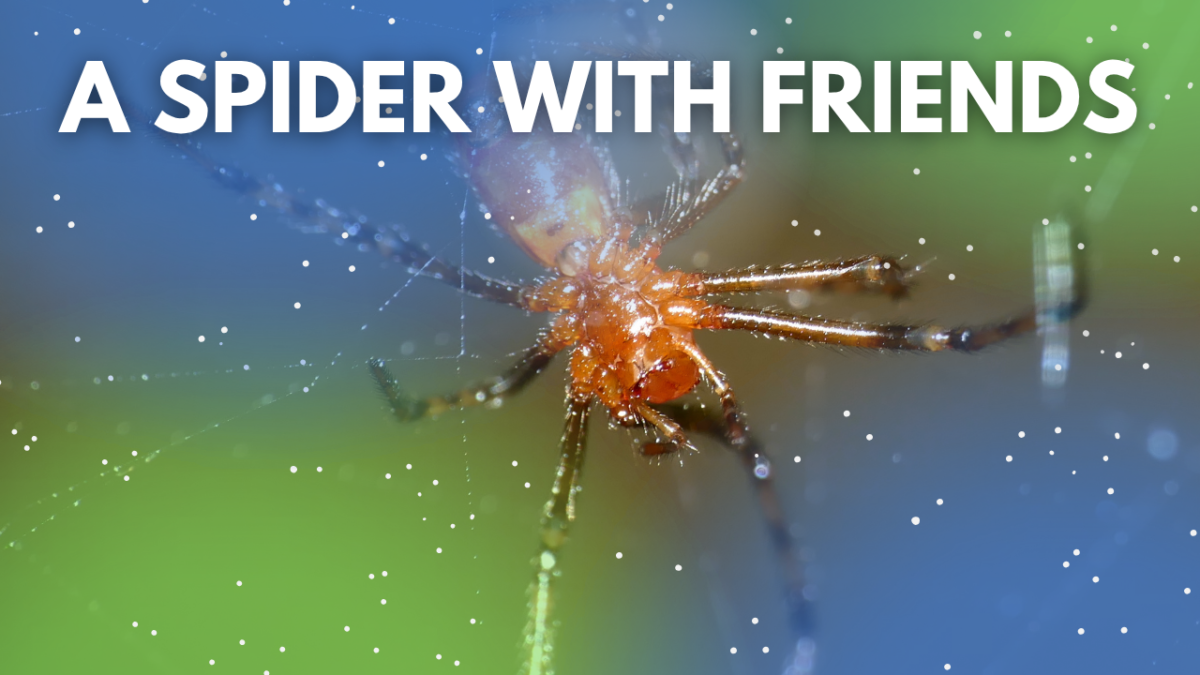
“…and today we’re talking about a spider with friends. But more on that later.”
Deep in the jungle, where the foliage is thick and the dinner guests are welcome, lurks a tiny terror with a talent for turning the local shrubbery into its own personal buffet: Anelosimus eximius. These eight-legged architects don’t believe in working alone, and their idea of a neighborhood watch involves a whole lot more silk than yours does. These little web developers have a corporate culture that would make a LinkedIn Rise and Grinder weep. But nature has shown time and time again that it’s better to work together than alone like Anelosimus eximius here in Life, Death, and Taxonomy.
Thank you to Daniel White for the use of his song “Make Pangea Unified Again.” To hear more of Daniel’s music please visit Youtube dot com slash DanielWhiteArtist.
Description of the Social Spider
Eximius have an orange-to-reddish prosoma and pinkish-to-orange/red abdomen with a distinctive notched dark band edged in white with some lateral white blotches.
All legs are dark brown.
Measure Up
Welcome to the beloved Measure Up segment. The official listener’s favorite part of the show! The part of the show when we present the animal’s size and dimension in relatable terms through a quiz that’s fun for the whole family. It’s also the part of the show that’s introduced by you when you send in audio of yourself saying, singing, or chittering the words Measure Up into ldtaxonomy at gmail dot com.
Female Length
4.4–6 mm in body length
In Tenochtitlan, two double aqueducts made of terracotta, provided the city with fresh water from the springs at Chapultepec. True or False – 1,333,333 female eximius go into the combined length of these aqueducts.
True. Each aqueduct was about 4 km (2.5 mi) long.
Males Length
Males are smaller (around 3.0–3.2 mm).
Mexico City is built on Tenochtitlan, located in the Valley of Mexico on the high Central Plateau, which was once in the middle of a lake. True or False – 600,087 male spiders go into the average elevation of Mexico City.
False. Mexico City sits at an average elevation of 2,240 meters (7,350 feet).
Fast Facts about the Social Spider
Eximius ranges from Panama through northern South America to southern Brazil, east to Trinidad and the Lesser Antilles, and west to Peru.
It lives in lowland tropical rainforests and second-growth forests… usually at forest edges, clearings, or around tree falls, from near ground level up to about 20 m in the canopy.
They make large web structures with:
- A roughly oval horizontal non-sticky sheet.
- Leaf retreats (leaves curled and silk-bound).
- Long vertical “knockdown” threads extending upward into the vegetation or canopy (sometimes several meters long).
Webs can be over 3 m across. They are maintained mainly by adult females and older juveniles; debris is dropped over the edge.
Large insects like wasps, bees, beetles, moths, butterflies, true bugs, cockroaches, and grasshoppers make up the bulk of biomass.
They reproduce year-round. Egg sacs contain roughly 17 to 53 eggs and are tended under leaves. Incubation lasts 20 to 30 days. Spiderlings remain under leaves initially, then move onto the main web around the third instar and begin participating in colony tasks.
Females mature later than males. Average adult lifespan is around 70–80 days (maximum recorded ~100+ days).
Major Fact: A Tenthousandfold Cord Isn’t Easily Broken/ O for a thousand webs to weave
Strength in numbers: Unlike most spiders, which prefer a solitary lifestyle, Anelosimus eximius lives in cooperative colonies. These communities can grow to tens of thousands of individuals.
Webs for days: The colony builds and maintains a sprawling, three-dimensional communal web. The upper sections intercept flying insects, while a basket-like nest below provides a place to live, reproduce, and raise young.
Teamwork makes the dream work: When an insect gets tangled in the web, vibrations travel through the silk, alerting nearby spiders that dinner has arrived.
A coordinated takedown: Multiple spiders converge on the trapped prey, biting and immobilizing it together. Their combined effort lets them capture animals that would be far too large for one tiny spider to handle alone.
Big prey, bigger payoff: Researchers have documented colonies capturing prey exceeding 2 inches in length. These oversized meals can provide a substantial amount of nutrition compared with the little insects a lone spider might catch.
A rising return on investment: Studies found that as colonies grow, the average size of prey captured increases dramatically. In one study, average prey size increased about twentyfold as colony size rose from fewer than 100 spiders to around 10,000. Some webs have even caught small birds.
Silk is their infrastructure: Maintaining such a large web requires ongoing construction and repairs. Colony members share web maintenance, helping keep the communal hunting system functional instead of leaving one exhausted spider responsible for the entire operation.
A nursery with multiple caregivers: The social lifestyle extends beyond hunting. Females cooperate in caring for egg sacs and feeding spiderlings, with some females helping raise offspring that aren’t their own. It’s the jungle equivalent of a very hairy daycare.
The system has its limits: Living together means sharing food and space, and competition can arise within the colony. Communal egg-sac cannibalism has also been documented, demonstrating that group living isn’t all friendship bracelets and potluck dinners.
A group project: Cooperation allows these spiders to exploit food sources that would be impractical for solitary hunters. By pooling their silk, labor, and hunting power, they turn a collection of millimeter-long predators into a formidable communal feeding machine.
Ending
So be chummy with your pals, try not to do a cannibalism, and put your webs together to punch way above your weight like the anelosimus eximus here in LDT.