
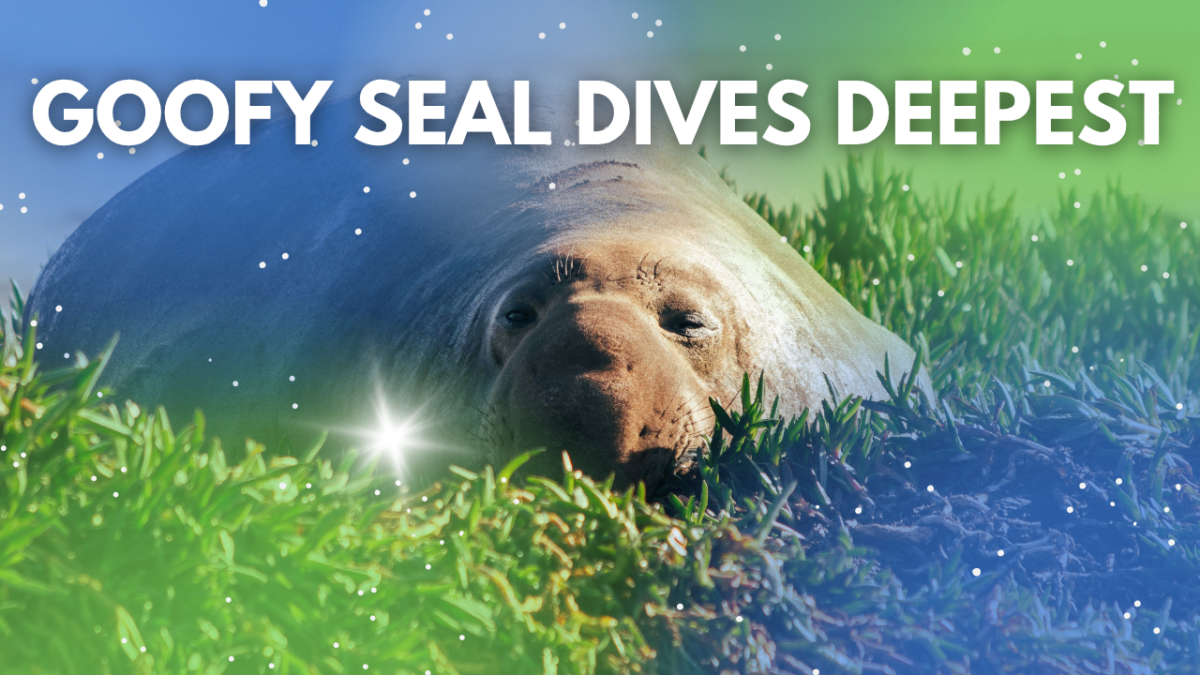
“…and today we’re talking about a deep diving elephant. But more on that later.”
The deeper you go in the ocean, the more alien it becomes… crushing pressure and oppressive darkness… It’s no place for a rotund mammal that spends several months of the year on land… but there’s food down there, and fewer things trying to eat that food. Alright, the elephant seal is convinced… he’ll dive to depths no other pinniped would dream of in Life, Death, and Taxonomy.
Description of the the Elephant Seal
- Basically a gigantic, blubbery torpedo with flippers
- Adults are dark gray, brown, or grayish-brown, with a smooth-looking but surprisingly wrinkly and leathery body
- Males are absolutely enormous compared with females and develop a giant inflatable nose called a proboscis that hangs over the lower lip
- Adult males also develop a thick, muscular neck covered in calloused skin, basically turning their upper body into a biological suit of armor
- Females have much smaller noses and a smoother neck, so they look considerably less like someone glued an elephant trunk onto a seal
- Pups are born with black fur and molt into a silvery coat after they are weaned
- During the annual molt, they shed their old fur and skin in large patches, giving them the appearance of a seal who has made some questionable decisions regarding sunburn
Measure Up
Welcome to the beloved Measure Up segment. The official listener’s favorite part of the show! The part of the show when we present the animal’s size and dimension in relatable terms through a quiz that’s fun for the whole family. It’s also the part of the show that’s introduced by you when you send in audio of yourself saying, singing, or chittering the words Measure Up into ldtaxonomy at gmail dot com.
Happy Feet – Elephant Seal screentime
- Adult males: typically 15–19 feet (4.6–5.8 m) long and can weigh 3,000–8,000 lb (1,360–3,630 kg).
- Adult females: around 9–10 feet (2.7–3.0 m) and roughly 900–2,000 lb (400–900 kg).
- Exceptional males: can reach about 20 feet (6 m) and nearly 9,000 lb (4,000 kg).
Length
19 feet (5.8 m)
Mount Everest is the highest mountain in the world, but do you know the tallest?
Mauna Kea in Hawaii is the tallest mountain from its base on the Pacific Ocean floor to its summit. True or False – 1,762 elephant seals go into the height of Mount Kea.
True: Kea reaches approximately 10,205 meters (33,480 feet).
Weight
8,000 lb
Open brain is a type of surgery, but it’s also a type of coral. Open brain coral is in the same family of reef building stoney corals called Merulinidae, which sometimes look like brains. But open brains have a much greater topography, with deep ridges and high bumps. True or false – 160 open brain corals go into an elephant seal.
True: Open Brain Coral (Trachyphyllia geoffroyi) can weigh up to 50 pounds (22.7 kg)
Major Fact: That’s Deep, Bro
Southern Elephant seals are among the top mammals with record dive depths… recorded at depths as low as 2,388 meters (7,835 feet). They sit just behind the Cuvier’s Beaked Whale record at 2,992 meters (9,816 feet). For comparison, the deepest free dive for a human was 253.2 meters (831 feet)… achieved by Herbert Nitsch in 2012 in Santorini, Greece.
Elephant seals dive deep primarily to hunt for food like deep-sea squid, rays, skates, and small fish… at those depths, there is a lot less competition from other animals.
Elephant seals are specially adapted for long, deep dives. Before diving, they exhale most of the air from their lungs, which reduces buoyancy and helps protect them from decompression sickness.
But then they have no oxygen stores… or do they?
Instead of relying on their lungs for oxygen, they carry large oxygen reserves in their blood and muscles. Elephant seals have an enormous blood volume, large blood-storage spaces, lots of oxygen-carrying red blood cells, and high concentrations of myoglobin in their muscles, allowing the muscles themselves to store substantial oxygen.
A normal surface heart rate of about 80 to 110 beats per minute can fall to roughly one-third of that when they are underwater. In extreme cases, it can drop as low as 3 beats per minute. Blood flow is restricted primarily to the heart and brain, and metabolism slows to reduce oxygen consumption.
Since their metabolism slows, they need to stay warm… They also have countercurrent heat exchange in their circulatory system. Warm arterial blood transfers heat to cooler returning venous blood, helping the seal maintain its body temperature while conserving energy.
Their dives have a roughly V-shaped profile, with the seals descending and ascending at about 2 to 5 mph (4 to 8 km/h). During most of the descent, they don’t actively swim—they glide, which saves energy. They can remain underwater for up to two hours and travel roughly 15,000 to 20,000 miles (25,000–32,000 km) per year.
But hunting down deep presents another problem. Sunlight really only reaches 1,000 meters down. Unlike the rest of the top dive deep mammal divers, they don’t have echolocation…
They hunt in near-total darkness. Instead, they use their large eyes to capture any light they can, not from the sun, but from the bioluminescence of prey like squid and octopuses. They also feel movement with very sensitive 3 to 8 inch whiskers on their faces.
Fast Facts about the Elephant Seal
- Range: Found throughout the Southern Oceans of the world all around Antarctica. As far north as central Patagonia in Argentina.
- Habitat: They spend most of the year in the open ocean and return to land for breeding, giving birth, and molting. Roughly nine months of the year can be spent at sea.
- Elephant seals are among the seals that can stay on land for the longest periods of time, as they can stay dry for several consecutive weeks each year
- Diet: Mostly squid and fish, but they’ll also chow down on rays, sharks, and other deep-ocean prey.
- Hunting: They forage almost continuously during long migrations, using repeated dives to hunt for prey in the open ocean.
- Mating: Breeding season is basically an enormous beach-based hierarchy tournament. Males compete for control of groups of females, using threats, roaring, and sometimes physical combat to establish dominance.
- Breeding: Females generally give birth to one pup each year and nurse it for about four weeks before leaving it to its own devices.
- Social Life: They’re mostly solitary while traveling and feeding in the ocean, but become extremely social during breeding and molting seasons, gathering in enormous colonies on beaches.
- Large males known as bulls will create harems of females and viciously fight for control
- Dominant males are called harem masters and have to defend their beaches all through mating season, which means constant fighting and sometimes months without food.
- Sounds: Adult males produce deep, guttural, almost drum-like calls with the help of their inflatable noses. Recent research shows individual males have distinctive vocal signatures that other males can recognize.
- Predators: Great white sharks are an important predator, particularly for young seals, while killer whales occasionally prey on them as well. Young seals face their greatest survival challenge during their first years at sea.
- Lifespan: They generally live around 13–19 years, with females typically outliving males. Some females can make it into their early twenties.
- Name Game: Mirounga comes from an Australian Aboriginal name for elephant seals
- They were almost toast: Southern elephant seals were hunted nearly to extinction in the 1800s, with only a few hundred thought to remain. Protection allowed the population to rebound dramatically.
Ending
So fight for your beachheads, narrowly escape extinction, and dive deep for your snacks like the southern elephant seal here in LDT.