
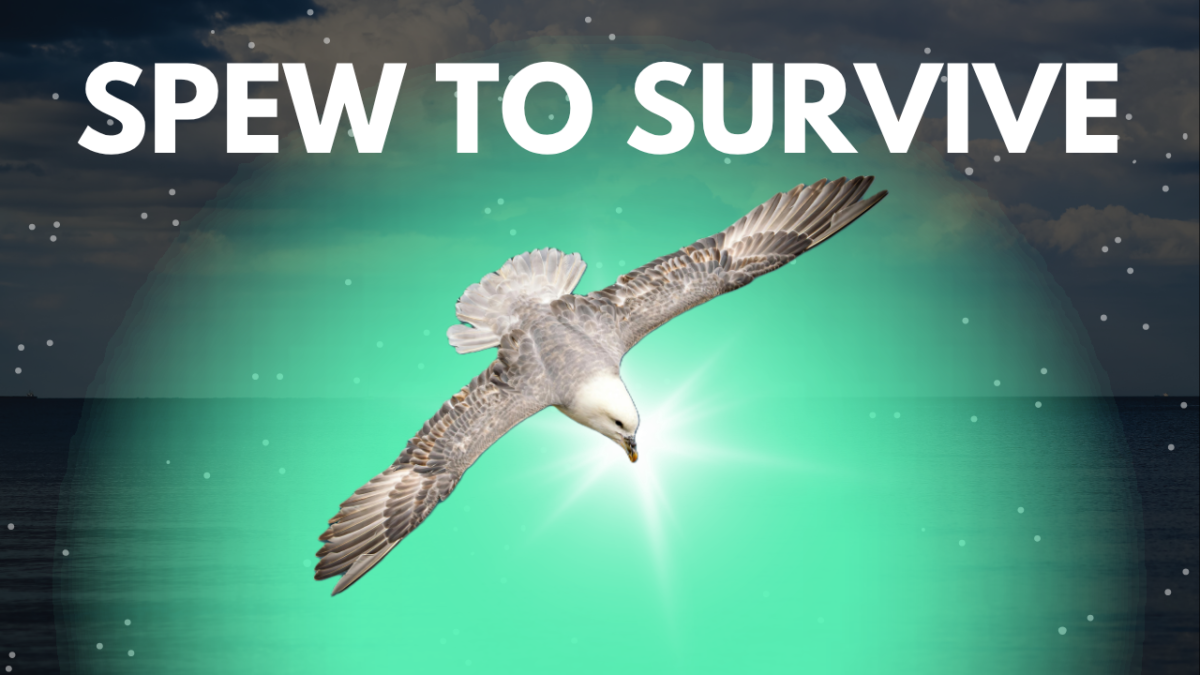
“..and today we’re talking about a fat baby sea bird. But more on that later.”
Out on the icy oceans of the Arctic, the Northern Fulmar floats above the waves—calm, collected, and carrying a concealed weapons permit. This bird doesn’t bluff, doesn’t bluster, and certainly doesn’t believe in backing down. Instead, it leans into a peculiar brand of defense that’s equal parts disgusting and disturbingly effective. Think less “fight or flight” and more “fight with… fluids.” It’s a slick, sinister solution to survival. But I guess war crimes don’t matter to animals like the Northern Fulmar here in Life, Death, and Taxonomy.
Description of the Northern Fulmar
Northern Fulmars are medium-sized seabirds found across the North Atlantic and North Pacific Oceans. They have:
- Stiff, straight wings for gliding
- A thick, tube-like structure on top of the bill (a key trait of their group)
- Color variations from light (white head and underside) to dark gray morphs
Measure Up
Welcome to the beloved Measure Up segment. The official listener’s favorite part of the show! The part of the show when we present the animal’s size and dimension in relatable terms through a quiz that’s fun for the whole family. It’s also the part of the show that’s introduced by you when you send in audio of yourself saying, singing, or chittering the words Measure Up into ldtaxonomy at gmail dot com.
This is what a Northern Fulmar sounds like!
New Patron: Rowan!
A very special thank you to our patrons. Thank you so much for your support, it’s greatly appreciated, thanks for helping us keep the lights on. If you’d like to donate just visit patreon.com/ldtaxonomy or click on donate on our website.
Wingspan
about 40–45 inches (102–112 cm)
Orcas are the largest extant members of the Delphinidae family. True or False – a male orca is equal to 8 fulmar wingspans.
An adult male orca is 26 feet long.
Adult weight
650–1,000 g (about 1.4–2.2 lbs)
Arktika was the first surface ship to reach the North Pole in 1977. It’s a Russian (formerly Soviet) class of nuclear-powered icebreakers. True or False – Arktika’s displacement is equal to 22,880,000 Northern Fulmars.
The Arktika class ship displaces up to 25,168 tons.
Fast Facts about the Northern Fulmar
Northern Fulmar are pelagic (open-ocean) birds of the North Atlantic, North Pacific, and Arctic oceans. They prefer cold waters over continental shelves and can even patrol near pack ice.
They breed on steep rocky cliffs or slopes on islands and coasts in subarctic and Arctic regions. Outside breeding season, they spend most of their time far out at sea, often hundreds of miles from land.
What do Fulmar Eat?
Northern Fulmars eat fish, squid, crustaceans, jellyfish, and occasionally carrion or scraps (including some garbage/plastics, which unfortunately makes them useful bio-monitors for ocean pollution).
They have a keen sense of smell for locating food and can dive up to about 10 feet (3 meters) underwater. Foraging happens day or night.
They may be eaten by foxes or larger birds (ravens, skuas and gulls) especially when they are young.
Life Cycle of the Northern Fulmar
Northern fulmar are among the longest-lived seabirds — regularly living into their 30s, with some records suggesting up to 60+ years possible.
They form long-term monogamous pairs, returning to the same cliff ledge or scrape year after year. They lay a single egg per season. Both parents incubate for ~6 weeks and feed the chick. Sexual maturity takes 6–12 years.
They nest in sometimes huge colonies and are known for loud cackling calls during courtship displays (head-bobbing, billing).
Other Fulmar Facts
They can handle brutal Arctic storms better than many other seabirds, using wind to glide efficiently with minimal effort.
Chicks fledge heavier than their parents (sometimes over 1 kg). In the final 1–2 weeks before fledging, the chick undergoes mass recession — it loses weight as the parents gradually reduce or stop feeding.
Unlike gulls, fulmars walk poorly on land but are masters of the air and sea.
Major Fact: Fowl Play: A Real Gut Reaction
- The Northern Fulmar defends itself by forcefully vomiting a foul-smelling, oily stomach substance at predators.
- This substance is composed of partially digested fish and a specialized stomach oil unique to seabirds in this group.
- The oil is sticky and hydrophobic, meaning it clings stubbornly to feathers and repels water.
- When predators—especially other birds—get coated, their feathers lose waterproofing and insulation.
- Without proper feather function, affected birds can’t regulate body temperature in cold ocean environments.
- The oil also weighs down feathers, making flight difficult or impossible.
- Many coated predators end up stranded in the water, unable to fly or escape.
- In cold seas, this can lead to hypothermia and, ultimately, drowning. Pretty brutal for what is technically “barf.”
- Fulmar chicks can also deploy this defense, giving them a built-in security system from a young age.
- Beyond defense, the stomach oil doubles as an energy-rich food reserve, making it a multi-purpose survival tool.
Ending
So spend your life as a wild rover at sea, keep a pouch of toxic nutrients handy in your belly, and vomit on your foes until they leave you alone like the Northern Fulmar here in LDT.